The Significance of Goldstar Air’s Belly and Tail For Job Creation
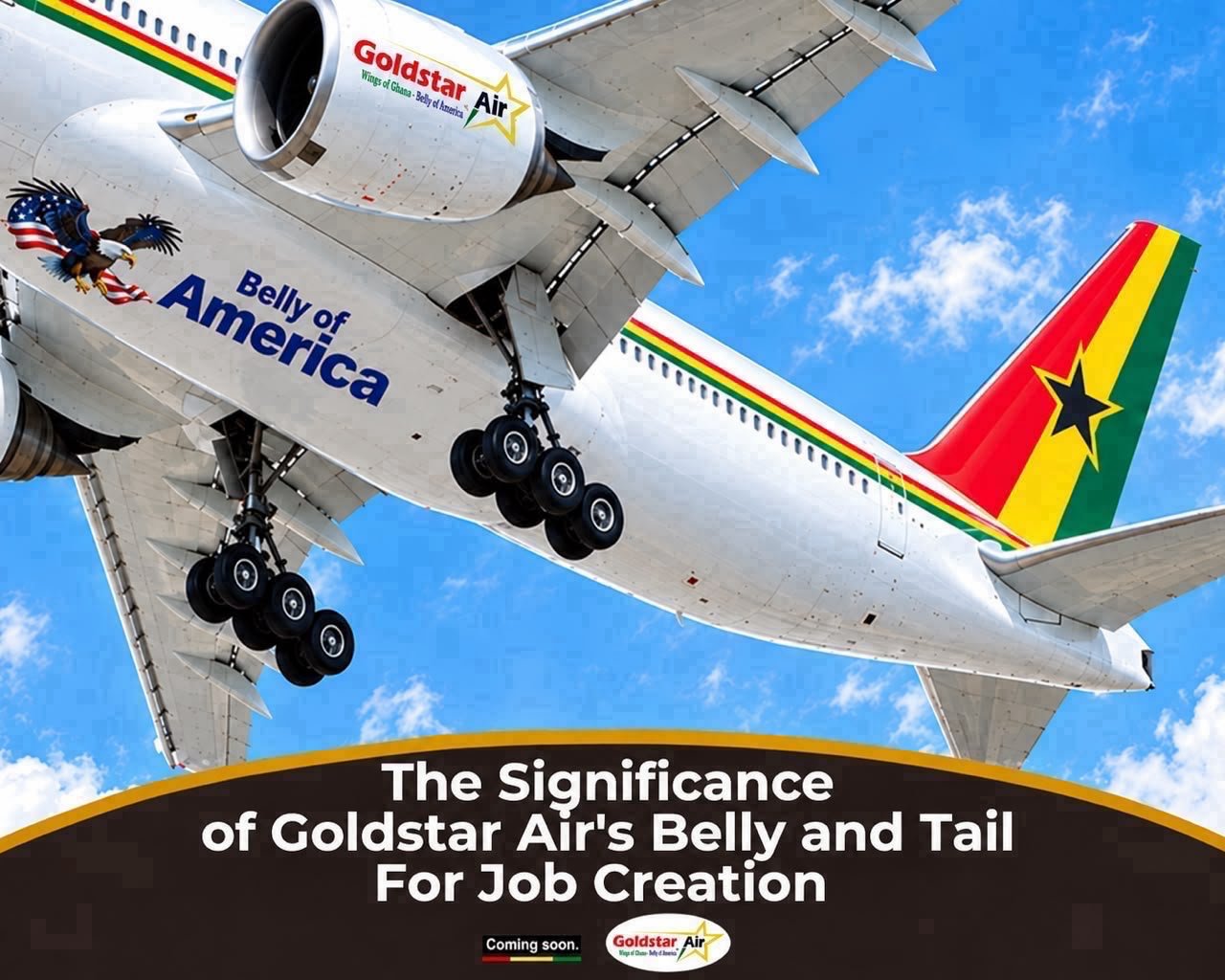
Credible airline Goldstar Air’s Belly and Tail are highly significant, reaching beyond the visible aircraft structure to have a substantial impact on job creation. They are symbols of the company’s broader economic mission to create employment opportunities. The airline’s planes feature striking underside branding, dubbed the “Belly of America,” which showcases a powerful eagle emblem symbolising strength and renewal, along with the words “We the People.” This symbolism reminds Goldstar Air that God gives power to the faint and increases the strength of those who have no might, even though the young and strong may grow tired and fall. While this Belly branding will not be visible from the ground, it will become visible after take-off and during landing, making it instantly recognisable to plane spotters. The airline’s Tail design is destined to be a showstopper, grabbing attention both high in the sky and on crowded airport tarmacs. The artistry of the design is evident in its thoughtful colour schemes and highly refined graphic icons, signifying the airline’s trademark identity, increasing brand awareness beyond airports and airfields, and supporting commercial gains for both the United States and Ghana. Goldstar Air passengers will also enjoy a flying experience filled with pride in both countries of registration. This initiative will create over two million direct and indirect job opportunities. The airline’s 24-hour strategic vision projects a fleet of more than one hundred modern aircraft operating to a network of over ninety key business and leisure destinations, as Goldstar Air strives to be recognized among the top one hundred companies in Africa.
Goldstar Air has introduced an end-of-year profit-sharing scheme in which the entire workforce will receive cash bonuses ranging from 4% to 10% of the company’s annual profits, because the airline’s management views every employee as a co-owner of the company. A monthly staff performance award scheme to motivate excellence will also be introduced once operations commence. The performance award scheme will recognise individuals and departments that consistently demonstrate excellence, innovation, teamwork, and dedication. Rewards will include various incentives, with top performers receiving all-expenses-paid vacations to any Goldstar Air destination of their choice. This initiative is designed to ensure exceptional service delivery, with passengers treated with the highest level of care, while also supporting the airline’s Project $1 Trillion Foreign Reserve Goal. Goldstar Air’s generational-thinking management team takes a broad, long-term view, carefully considering the potential impact of decisions on the company’s future before acting. The airline’s branding is simple yet effectively transcends geography, culture, and language to communicate universal themes associated with its 24-hour service initiative. Goldstar Air has a strong family succession plan in place to ensure that the airline remains a global giant company forever, and will not allow any takeover now or in the future, including any change of trademark.
The Director-General of the Ghana Civil Aviation Authority (GCAA), Rev. Stephen Wilfred Arthur, must do the needful by tasking the Safety Department to get a qualified third party as a solution to finalise Goldstar Air’s wide-body Safety Certification (AOC) process immediately, for which an administrative fee will be charged to the airline, and Goldstar Air is ready and willing to pay. The completion of the Safety Certification will enable the change of the airline’s wide-body aircraft nationality, allowing them to be registered under the Ghana Aircraft Registry (State of Registry), thereby enhancing Ghana’s broader aviation reputation. The Director-General must also bear in mind that the GCAA is not a family-run or family-controlled organisation. This is purely nepotism and cronyism, that leads to corruption within the Authority, thereby impeding progress of the Ghanaian youth, and a major disservice to the taxpayers, including selective retirement ages. The 21st century demands an end to outdated colonial methods and a change that embraces a new generation of leaders equipped to tackle modern challenges.
The Head Pastor of Kingdom Family International Church at Abeka Lapaz, and Director-General of the Ghana Civil Aviation Authority, Rev. Stephen Wilfred Arthur, must know that although the Authority operates as an autonomous statutory government agency, it remains accountable to the state through the Ministry of Transport to ensure alignment with national goals. The International Civil Aviation Organization (ICAO) also sets global Standards and Recommended Practices that the Ghana Civil Aviation Authority must follow, including audits, similar to the way FIFA functions, and the Authority can be suspended. ICAO creates international rules for flight safety, security, and environmental protection, and Ghana, as a member state, must comply with these rules in its local laws and daily work, which the Director-General of GCAA is mandatory to apply same laws to Goldstar Air, yet the Authority is choosing a different approach. Therefore, the Ghana Civil Aviation Authority is sabotaging the Resetting Agenda of the Government of Ghana by impeding the issuance of Goldstar Air’s Safety Certificate and hindering the nation’s progress.
Economic progress, regardless of its source, should be recognised and supported. Goldstar Air is driven not only by profit, but also by purpose: the capacity to unlock human potential and create opportunities for individuals to thrive. Businesses become instruments of national progress, social impact, and human empowerment when corporate initiative aligns with transformational ideals. Goldstar Air’s 24-hour operations are poised to revolutionise Ghana’s economy by creating over two million direct and indirect, well-paying, and sustainable job opportunities, while significantly reducing unemployment and underemployment among Ghanaian youth. The Ghanaian youth cannot wait any longer in the ghettos; they need their well-paying jobs now. The country’s future growth hinges on the success of Goldstar Air’s employment drive, which is poised to unlock Ghana’s productivity potential and create enormous opportunities in agriculture, tourism, aviation, manufacturing, logistics, technology, mining, energy, education, and international trade. The airline is strategically positioned within West Africa to serve as a gateway to the African continent. Nations do not move forward by tearing down their builders, but by encouraging them and inspiring others to rise.
The importance of entrepreneurship in economic growth has been increasingly recognized in the 21st century. Economists now understand that entrepreneurial ventures have long-lasting positive impacts on the development and prosperity of societies and national economies. Great countries such as the United States have been built by entrepreneurs, supported by political systems that protect citizens’ rights and freedoms and promote the rule of law. Entrepreneurship is a noble pursuit that offers both personal and societal benefits. Even if a business does not become a household name, its positive impact remains significant. Businesses create jobs, drive innovation, and contribute to economic growth. Entrepreneurs make a meaningful difference, and that contribution deserves recognition.
Goldstar Air’s Belly and Tail also play an important role in strengthening cultural diplomacy between the United States and Ghana. The airline will continue to promote cultural exchange between the two countries through music, film, education, sports, fashion, and art. Ghanaian culture continues to influence global audiences, while American cultural industries remain widely consumed in Ghana. Aviation serves as the physical bridge that enables artists, filmmakers, performers, scholars, and cultural ambassadors to move between both countries, sharing creativity and building mutual understanding. Goldstar Air recognises that cultural diplomacy is a powerful tool for strengthening international relationships because it fosters empathy, appreciation, and respect among diverse populations.
Ghana is the host country of the African Continental Free Trade Area (AfCFTA); therefore, Goldstar Air’s operations from Ghana will create access to a continent-wide market embracing fifty-four countries. The African continent is currently undergoing major transitions across technology, energy, infrastructure, agriculture, and digital finance. It is projected to be the eighth-largest global economy by 2050 and home to about a quarter of the world’s population, approximately 2.5 billion people, with projected purchasing power of US$16.3 Trillion. Goldstar Air has the potential to command a significant market share in the Gross Domestic Product (GDP) of aviation, tourism, and other industries.
Goldstar Air represents the execution of a strategic economic instrument designed to drive industrialization, cultural diplomacy, tourism expansion, job creation, and continental integration. The airline believes that Ghana remains the true “Gateway to West Africa” and that aviation is one of the most powerful engines for propelling Africa towards economic independence. The airline’s initial 18 routes from Washington, London, Dubai, Guangzhou, Rhode Island, Rome, Düsseldorf, Madrid, Milan, Hamburg, and Toronto to key African cities such as Lagos, Freetown, Abidjan, Dakar, Banjul, and Monrovia.. Accra, Kumasi, and Tamale International Airports will serve as the primary Ghanaian gateways for the airline’s strong multi-hub network, facilitating the efficient movement of people, goods, and opportunities.
Goldstar Air is also negotiating codeshare agreements with other airlines, enabling it to offer a broader route network and provide passengers with more travel options between all fifty states in the United States. The airline believes these agreements will benefit its partners by increasing brand visibility, expanding market knowledge of Africa, facilitating trade and investment, and encouraging economic growth. Goldstar Air welcomes the new U.S Embassy Public Affairs Officer, Pam DeVolder to Ghana. Her appointment comes at a significant moment as Ghana and United States prepare to celebrate 70 years of diplomatic relations in 2027, further strengthening the longstanding partnership between the two countries. Speaking at a reception organized by the U.S Embassy in Accra on Thursday, September 17, 2026. Mr Rolf Olson, Charge d’Affaires, formally welcomed Ms DeVolder to the mission and expressed confidence in her ability to advance the Embassy’s public diplomacy agenda. Mr Olson also commended Press Attache Matthew Asada and Cultural Affairs Attache Donya Eldridge to their leadership as acting section chiefs over the past year, and praised the wider Public Diplomacy team for its work in deepening relations between the United States and Ghana.
Commercial aviation is a key driver of global economic prosperity and provides the only rapid worldwide transportation network, making it essential for global businesses. It fosters economic growth, creates jobs, and facilitates international trade and tourism. Commercial aviation in 2023, accounted for 5% of the United States’ Gross Domestic Product (GDP), equivalent to US$1.37 Trillion. United States airlines operate more than 26,000 flights daily, carrying 2.6 million passengers to and from nearly 80 countries and transporting 61,000 tonnes of cargo to and from more than 220 countries.
Goldstar Air, as a United States registered company with a strong relationship with Boeing, has committed the airline to prioritize Boeing commercial airplane series, especially the Boeing 787 Dreamliner and 777X variants, which are ideal for the airline’s intercontinental routes from the centre of the world. There is strong customer demand for the B787, which has earned the title of the best-selling passenger wide-body aircraft in history. It has carried more than one billion passengers within 15 years and helped airlines open more than 540 new nonstop routes that were never previously served. Goldstar Air’s collaboration with Boeing will lead to greater productivity, job creation, increased revenue for Boeing, and overall economic growth in the United States. The airline is focused not only on acquiring aircraft but also on ensuring their long-term maintenance to support aerospace sustainability. Goldstar Air’s management projects a fleet of more than 100 modern aircraft serving a network over 90 key business and leisure destinations, with the ambition of being recognized among the top 100 companies in Africa.
Boeing President and Chief Executive Officer Kelly Ortberg said in an interview with CNBC that the company is continuing to execute its business plan for the year and building trust with better performance and better production. That is driving higher revenues and improved cash flow, which Goldstar Air is already contributing. The airline also acknowledges The Boeing Company’s recently announced $1 billion expansion of its South Carolina facility to increase production of the 787 Dreamliner. This project is expected to create more than 1,000 new jobs over the next five years, in addition to the more than 8,200 employees already working at Boeing’s South Carolina campuses. The expansion directly responds to high global demand for the 787 Dreamliner.
Goldstar Air will make Ghana a leading aviation and logistics hub in West Africa and envisions itself as a catalytic force in that transformation. Goldstar Air’s long-term ambition aligns with Ghanaian development goals that emphasize trade expansion, tourism growth, industrialisation, job creation, export enhancement, and regional integration. The United States, with its vast consumer market and advanced industrial capacity, remains one of the most important destinations for Ghanaian goods, services, ideas, and human capital. Reliable and efficient aviation connection between Ghana and the United States is therefore not just a commercial necessity, but also strategic economic infrastructure that determines how effectively both nations can engage in mutually beneficial development.
Every part of Goldstar Air’s aircraft will carry purpose, but the Belly and Tail hold particularly powerful meanings when considered through the lens of development, trade, employment, skills transfer, tourism, logistics, identity, and economic transformation. The Belly represents capacity: the space beneath the passenger cabin where cargo, mail, medicines, agricultural produce, machinery, spare parts, e-commerce consignments, and commercial goods will be carried across cities, countries, and continents. The Tail represents identity: the part of the aircraft that carries the colors, the airline’s brand, its promise, its reputation, and its message to the world.
Job creation is often discussed as though it begins only when a company places a vacancy announcement. That understanding is too narrow. Goldstar Air will create direct employment for pilots, engineers, flight attendants, customer-service professionals, cargo handlers, dispatchers, accountants, security personnel, information-technology specialists, caterers, drivers, cleaners, marketers, lawyers, and administrators. Employment will also be created indirectly as other businesses grow. The airline will not merely carry people from one airport to another. It will activate taxis, hotels, restaurants, farms, warehouses, travel agencies, insurance companies, aircraft-maintenance firms, tourism operators, fuel suppliers, fashion designers, exporters, photographers, digital-service providers, logistics companies, event organizers, retailers, industrial farms and countless small and medium-sized enterprises.
According to the Chairman and Chief Executive Officer of Goldstar Air, Eric Bannerman, the airline’s intercontinental service will emerge as a crucial driver of economic growth and development in both the United States and Ghana. Goldstar Air’s aircraft registration numbers and letters will feature references to prominent historical sites and personalities as a way of honouring them while promoting tourism. The airline has a unique naming pattern for aircraft registered in Ghana, which includes designations such as 9G–H.E. John Mahama, 9G–H.M. Otumfuo Osei Tutu II, 9G–H.E. George Weah, 9G–H.E. Sheikh Osman Nuhu Sharubutu, 9G–H.M. Abdulai Jinapor II, 9G–Tetteh Quarshie, and 9G–Dr. Kwame Nkrumah, among others.
Goldstar Air’s initiative will enhance aviation, trade, tourism, and economic cooperation between Africa and United States, with Ghana serving as strategic gateway to the African Continent. The airline’s management has formally written to the President of the United States, His Excellency Donald J. Trump, to seek permission to emboss his name in bold, gold lettering on one of its aircraft. This symbolic gesture is intended to honor and commemorate both the Nobel and FIFA Peace Prizes in a lasting, dignified, and globally visible manner. Goldstar Air is eagerly looking forward to meeting the President at the White House at His convenience and celebrating this extraordinary milestone in leadership and global peace. The airline also looks forward to welcoming His Excellency Donald J. Trump onboard Goldstar Air as a special guest in the future.
The core brand identity of Goldstar Air is reflected in its primary corporate colors, which prominently feature red to symbolize the airline’s dynamic and energetic spirit, conveying a sense of urgency and efficiency. Yellow and gold symbolize the warmth and hospitality of Goldstar Air’s services while also representing success, achievement, and luxury. White represents clarity, simplicity, and innovation in Goldstar Air’s operations.
The color blue represents the airline’s trust in God, loyalty, wisdom, and the total unity of the workforce, reflecting its strong position in the aviation industry. Blue also provides a sense of stability and reliability, reflecting Goldstar Air’s commitment to faith, safety, and customer satisfaction. Green represents growth, harmony, and balance, highlighting the airline’s commitment to environmental sustainability and customer well-being.
The black star with a yellow-gold border adds a touch of sophistication and elegance, emphasizing Goldstar Air’s commitment to excellence and professionalism. The star symbol, bordered in gold, also represents guidance, direction, and excellence, signifying the airline’s commitment to navigating customers safely and efficiently to their destinations.
The eagle soaring majestically in flight symbolizes the freedom and empowerment that Goldstar Air offers its passengers. The strength and resilience of the eagle’s powerful wings and sharp vision represent the strength and resilience of Goldstar Air as it navigates to new heights. The eagle’s keen eyesight and soaring altitude symbolize Goldstar Air’s visionary leadership, always looking ahead, with no liabilities as of today. The eagle’s effortless flight also represents the aspirational spirit of Goldstar Air, inspiring its workforce to explore new horizons and strive toward their dreams, including receiving end-of-year profit sharing.
Goldstar Air’s overall color scheme is a blend that conveys energy, warmth, growth, purity, innovation, and sophistication, conveying a sense of dynamic and efficient service, luxurious travel experiences, environmental responsibility, and professional excellence. This color scheme effectively communicates Goldstar Air’s values and mission, creating a strong corporate brand identity within the global aviation industry. All these vibrant colors originate from the divine power of God and reflect the principle, “In God We Trust.”
The aviation industry itself represents one of humanity’s greatest achievements. It has fundamentally transformed global commerce, tourism, diplomacy, education, healthcare, emergency response, and international cooperation. Aircraft connect continents within hours, bringing people together in ways unimaginable just over a century ago. Goldstar Air proudly embraces this extraordinary responsibility by aspiring to provide reliable, safe, efficient, and customer-focused services that strengthen Ghana’s connections with major international markets, including the United States.
Tourism is one of the sectors most closely connected to airline identity. Visitors need access, information, confidence, and compelling reasons to travel. Goldstar Air’s Tail will help market Ghana as a destination for heritage tourism, business tourism, cultural tourism, eco-tourism, sports tourism, culinary tourism, educational tourism, conference tourism, religious tourism, and diaspora tourism. Every additional visitor will support jobs across hotels, guesthouses, restaurants, transport services, tour companies, museums, event venues, craft markets, photography businesses, entertainment enterprises, and local retail.
The tourism effect will extend beyond Accra. Ghana has destinations and communities with stories that deserve wider international attention. Cape Coast and Elmina hold profound historical significance. Kumasi offers rich cultural heritage, craft traditions, commerce, and Asante history. Tamale and the northern regions offer landscapes, cultural experiences, festivals, agriculture, and opportunities for community-based tourism. The Volta Region offers mountains, lakes, waterfalls, and eco-tourism potential. The Western Region offers beaches, heritage sites, and emerging business opportunities. The Central Region offers history, hospitality, and natural beauty. The Eastern Region offers adventure, retreats, and agricultural activity.
Goldstar Air will actively promote these destinations and help distribute tourism income more widely to tap into the $10.9 Trillion global tourism stream. This matters because job creation is more meaningful when opportunity reaches different regions and communities. A visitor who spends money only in one major city creates some value, but a visitor who travels through several parts of the country will support a much broader network of enterprises. Goldstar Air’s international identity, network planning, marketing, and partnerships will help make this kind of distributed tourism more achievable.
The airline’s 24-hour service will introduce African traditional drinks on all flights as part of its role in promoting agribusiness at 30,000 feet above sea level. The on board menu will feature authentic indigenous African traditional drinks, including Chapman, Asaana, Sobolo, Pito, Burkina, Lamugin, and Palm Wine, a sweet alcoholic drink fermented from palm-tree sap and traditionally served in a local calabash. Additionally, passengers will enjoy Ghana’s signature Golden Tree chocolate drinks and bars, which form part of the airline’s brand identity.
The menu will also include a variety of popular Ghanaian delicacies such as plantain chips, koose, roasted plantain, tapioca, ekuegbemi, tiger-nut pudding, oblayoo, massa, kuli-kuli, akpiti, adonlee, kelewele, acheke, waakye, fufu, kenkey, banku, red red, Ghana jollof, abolo, yakayaka, aboboi, and tatale. Some of these meals will be available upon request during booking or through pre-ordering before the flight. This initiative will create an exciting culinary experience for passengers while providing significant opportunities for Ghanaian food and beverage companies as Goldstar Air showcases local delicacies to a global audience.
Mr. Bannerman emphasized that the importance of the airline’s Belly and Tail lies in the fact that they are symbols of the company’s broader economic mission to create employment opportunities. Aviation is not a stand-alone industry; it is an enabling industry that creates value by helping other sectors move faster, reach farther, and compete more effectively. The Belly provides space for commerce. The Tail provides visibility for the airline. The aircraft connects both. This connection is supported by sound regulation, safety, operational discipline, training, investment, strong partnerships, and sustainable business planning. Goldstar Air’s initiative therefore deserves to be understood not merely as the possible establishment of another airline, but as a potential employment ecosystem that will contribute to Ghanaian broader aspirations for industrial growth, youth empowerment, export expansion, tourism development, regional integration, and a stronger 24-hour economy.
The belly of an aircraft is frequently overlooked by ordinary travelers because it is not always visible from the passenger seat. Yet, commercially, it is one of the most valuable spaces in aviation. Beneath the cabin floor lies an opportunity to carry goods that sustain businesses, support families, improve access to essential supplies, and strengthen international trade. For Goldstar Air, the Belly will become an economic tool whose value is measured not only in cargo revenue, but also in the number of livelihoods it helps create across Ghana and beyond.
Every cargo shipment begins with people. Before any product enters an aircraft, somebody must grow it, manufacture it, package it, label it, inspect it, insure it, transport it, warehouse it, document it, clear it, load it, track it, receive it, distribute it, market it, and sell it. This means that Goldstar Air’s belly-cargo operation will activate a broad chain of employment. The farmer who cultivates fresh produce, the cooperative that aggregates it, the cold-room operator who preserves it, the packaging company that prepares it for export, the quality-control officer who confirms standards, the freight forwarder who arranges transportation, the customs broker who completes documents, the cargo handler who builds the shipment, and the delivery firm that brings it to the final customer will all be part of the same aviation-enabled value chain.
This is particularly important for Ghanaians because the country possesses a wide range of products with the potential to command international attention. Ghanaian cocoa is globally respected, but the greater opportunity is not limited to exporting raw beans. Value-added cocoa products such as chocolates, cocoa powder, cocoa butter, cosmetics, beverages, confectionery, and specialized food products will create more employment when they are produced, packaged, branded, and exported locally. Goldstar Air’s cargo capacity will help create faster routes for these products to reach international consumers, specialty retailers, hotels, restaurants, wholesalers, distributors, and diaspora markets. The more Ghanaians export finished and branded products, the more jobs will remain within the country.
The Belly signals that America is present, connected, capable, and also has enormous significance for e-commerce. The rise of online purchasing has changed the expectations of consumers and businesses across the world. Customers want products to arrive faster. Small businesses want to reach buyers beyond their physical locations. Sellers want simple, traceable, and affordable delivery systems. Goldstar Air’s cargo operation will support an e-commerce economy in which Ghanaian entrepreneurs are able to sell goods not only within their immediate communities, but also to customers in West Africa, the wider African continent, Europe, North America, the Middle East, and Asia.
Fashion designers in Accra, Kumasi, Tamale, Ho, Takoradi, or Sunyani will be able to sell locally designed garments to customers abroad without treating international delivery as an impossible barrier. Craft producers will be able to ship handmade products to buyers in London, New York, Dubai, Lagos, or Johannesburg. Cosmetic entrepreneurs will be able to send natural beauty products to diaspora customers. Ghanaian authors will be able to distribute books internationally. Music producers will be able to transport equipment and merchandise efficiently. Small technology companies will be able to move prototypes, spare parts, and customer orders with confidence.
Goldstar Air’s belly will contribute to this future by supporting courier services, freight forwarding, consolidated shipping, express parcels, online retail fulfillment, customs support, warehousing, and last-mile delivery. Each of these services will create employment. They will create work for software engineers, warehouse staff, dispatch officers, delivery riders, drivers, customer-support agents, packaging companies, inventory specialists, payment-service providers, and small-scale retailers. They will create opportunities for young people who are already familiar with mobile technology, social-media marketing, online storefronts, and digital customer engagement. The airline will make logistics more dependable, helping to unlock this distributed form of employment and give microbusinesses the confidence to become small businesses, help small businesses become medium-sized businesses, and help medium-sized businesses become exporters. The belly of Goldstar Air will become a practical instrument for this upward journey.
The Tail of Goldstar Air is equally significant because it will represent Ghanaian in the skies of the world. The tail is a moving Ghanaian symbol. Whenever it is seen at an airport abroad, it will speak before the aircraft door opens. It will signal that Ghana is present, connected, ambitious, capable, and ready to participate more strongly in global aviation, tourism, trade, and investment. The airline’s identity will support Ghanaian pride, commercial confidence, destination marketing, and cultural visibility. It will inspire young people to see aviation not as a distant profession reserved for others, but as a field in which they, too, can become pilots, engineers, cabin crew, logistics professionals, data analysts, air-traffic specialists, entrepreneurs, and leaders.
Goldstar Air’s Tail also adds another dimension to this initiative. While the Belly will perform the practical work of carrying goods, representing the Belly of America, the Tail carries the emotional and strategic work of representation. It represents what the airline stands for. It represents Ghanaian ambition, Ghanaian culture, Ghanaian professionalism, and Ghanaian participation in an industry that shapes global mobility. Whenever an aircraft tail carries a distinctive identity, it becomes a visual ambassador. It is seen by passengers, airport workers, investors, tourists, cargo operators, aviation professionals, journalists, and communities across the network.
Identity matters in aviation because airlines often become symbols of the countries they represent. They appear on airport ramps, in travel advertising, on digital platforms, in international media, at tourism exhibitions, and in the memories of travelers. Goldstar Air’s initial 18 destinations will help strengthen the images of both the United States and Ghana as places of enterprise, hospitality, safety, creativity, and connectivity. For Ghana, this will support wider efforts to attract investment, encourage tourism, expand trade, and promote cultural influence.
The Tail will become a platform for Ghanaian storytelling. It will carry colors, symbols, design elements, and messaging that will make passengers curious about the country. It will communicate warmth, confidence, resilience, heritage, and modernity. It will encourage people abroad to visit Ghana, conduct business in Ghana, buy Ghanaian products, attend Ghanaian events, study in Ghana, collaborate with Ghanaian companies, and reconnect with Ghanaian communities. In this sense, the Tail will help generate economic activity long before a passenger lands.
The Tail will also serve as a platform for cultural diplomacy. Ghanaian music, fashion, food, storytelling, art, film, sports, and hospitality will travel with the airline’s brand. Passengers experience will begin before boarding and continue after landing. In-flight entertainment will feature Ghanaian artists. In-flight magazines will showcase local entrepreneurs and destinations. Catering will introduce Ghanaian cuisine. Social-media campaigns will spotlight artisans, tourism businesses, exporters, and innovators. Airport lounges will display local art. Uniforms will incorporate tasteful Ghanaian design. Partnerships will feature local brands. These activities will appear promotional, but they have employment consequences. When local products and creative talents receive visibility, demand will grow. More demand will lead to more production, more sales, more contracts, and more jobs. A designer whose work is featured will hire more tailors. A food supplier who serves airline catering will increase purchases from farmers. A musician whose work reaches international passengers will gain new performance opportunities. A craft business featured in an airline publication will secure export orders. A hotel highlighted in a travel campaign will employ more staff.
Goldstar Air’s Tail will therefore be seen as a commercial billboard in the sky, but it will also be understood as a marketplace of ideas and opportunity. The Tail will symbolize Ghanaian readiness to lead through connection rather than isolation. The Belly will make that connection commercially practical by carrying the physical goods that trade requires. Together, they will reflect a philosophy of economic openness rooted in the airline’s confidence. The airline connecting with the world will strengthen United States and Ghanaian identities by sharing its value with the world.
The connection between the Belly and diaspora markets will be especially important for products with cultural meaning. Ghanaian textiles, kente, traditional garments, locally made jewelry, herbal products, food ingredients, sculptures, artworks, and ceremonial items often carry emotional value for people living abroad. The airline will help these products reach customers more directly. It will support entrepreneurs who want to turn heritage into sustainable commerce. It will help make Ghanaian creativity more visible in global markets. Goldstar Air’s Tail will support this by presenting a brand that diaspora communities recognize as an expression of home. The airline will be more than transport for many travelers. It will become part of the experience of returning, reconnecting, investing, and belonging. Goldstar Air will deliver professional service, respectful hospitality, reliability, and also a compelling United States-Ghanaian identity, to build loyalty that strengthens both passenger traffic and commercial opportunity.
Goldstar Air’s 24-hour economy gives further depth to its job-creation potential. Aviation naturally operates across time zones and does not fit neatly into ordinary daytime schedules. Aircraft will arrive at night. Cargo will be processed in the early morning. Maintenance will be conducted during non-flying hours. Customer-service centers will support international passengers around the clock. Warehouses will receive and dispatch shipments at different times. Hotels, restaurants, transport providers, security teams, fuel suppliers, and airport services will all operate beyond conventional office hours.
The 24-hour aviation economy will create different shifts and different forms of work. It will provide opportunities for people who are able to work evenings, nights, weekends, and rotating schedules. It will encourage businesses to organize more efficiently. It will support the faster movement of time-sensitive goods. It will help connect Ghanaian exporters to international delivery schedules. It will allow maintenance work to occur while aircraft are on the ground, improving productivity and supporting more technical employment.
The Belly is essential for the airline’s 24-hour cargo initiative because it will benefit most from overnight movement. Goods will be collected during the day, processed in the evening, flown at night, cleared in the morning, and delivered in time for commercial activity. This will be especially valuable for e-commerce, pharmaceuticals, perishable goods, business documents, emergency supplies, and high-value products. The speed of aviation will reduce inventory delays, improve customer satisfaction, and make Ghanaian companies more competitive.
The Tail reinforces this 24-hour initiative by giving the airline a recognizable public presence across markets and time zones. Whether seen on an airport apron in Africa, Europe, the Middle East, North America, or elsewhere, the aircraft will represent a Ghanaian business that is participating in global commerce. It will communicate that Ghana is open for trade, ready for tourism, interested in partnerships, and capable of supporting international movement.
Goldstar Air’s operations will create demand for taxi and ride-hailing services, bus services, car rentals, parking services, airport hotels, catering suppliers, laundries, cleaning contractors, landscaping firms, baggage services, duty-free suppliers, travel agents, advertising agencies, interpreters, currency-exchange services, and digital-payment providers. This is why the economic contribution of Goldstar Air must be measured beyond airline payroll. The airline will create a network of dependent and complementary businesses.
Construction is another important area. The development of training facilities, maintenance hubs, cargo warehouses, office spaces, staff accommodation, hangars, cold-storage facilities, terminals, access roads, and support infrastructure will create employment for architects, engineers, surveyors, electricians, plumbers, welders, masons, painters, carpenters, equipment suppliers, safety professionals, and construction laborers. Local procurement will be prioritized where practical and where quality standards are met, ensuring that more of the economic benefit remains within Ghana.
Goldstar Air’s Belly will anchor a cargo and logistics cluster. The Tail will anchor a brand, tourism, and Ghanaian-promotion cluster. Together, they will help turn aviation into an ecosystem rather than a single company. This is the deeper meaning of Goldstar Air’s job creation. One airline job will support several indirect jobs. One cargo route will support multiple businesses. One new destination will create demand for accommodation, transport, trade, events, and tourism. One training center will prepare a generation of professionals.
The airline will also provide strong customer service, creating further employment opportunities. Passenger experience depends on reservation agents, call-center personnel, digital-support teams, check-in agents, gate agents, cabin crew, lounge attendants, baggage-service staff, complaint-resolution professionals, and customer-experience managers. These roles require communication, empathy, patience, professionalism, language skills, technology knowledge, and cultural awareness. They will create valuable employment for graduates and experienced workers alike.
Goldstar Air’s customer service will also increase the airline’s wider reputation. Passengers will feel respected, informed, safe, and valued; they will return, recommend the airline, and support its growth. This will reinforce the relationship between service quality and job creation. The strong reputation will lead to increased demand. Increased demand will lead to more flights, more routes, more cargo, more staff, and more contracts for suppliers. The Belly and Tail then becomes more than a design; it becomes a symbol of trust.
Trust is central to aviation. Customers must trust that flights will operate safely, cargo will arrive responsibly, schedules will be managed transparently, staff will act professionally, and problems will be addressed fairly. Investors must trust that the business is governed responsibly. Regulators must trust that safety and compliance are not compromised. Employees must trust that the organization values their development and welfare. Suppliers must trust that contracts will be handled honorably. Communities must trust that promised benefits are pursued with sincerity.
The Tail will communicate ambition, and Goldstar Air’s employees will deliver it. The Belly will carry opportunity, and the supply chain will support it. Human capital is the true center of the entire initiative. Aircraft are important, facilities are important, routes are important, and branding is important, but people make aviation work. People maintain aircraft. People secure airports. People handle cargo. People respond to customers. People teach trainees. People plan routes. People sell tickets. People design systems. People prepare food. People manage finance. People build partnerships. People ensure compliance. People transform a vision into an institution.
The Belly represents the practical side of this transformation. It is where goods are loaded, secured, documented, and transported. It is the economic space where producers meet markets. It is the hidden engine that will carry export growth, e-commerce, medical logistics, agricultural opportunity, manufacturing ambition, and entrepreneurial possibility. It will support jobs in warehouses, farms, factories, offices, airports, delivery networks, and international sales channels.
The Tail represents the visible side of transformation. It is where the airline announces itself to the world. It is the symbol that will carry colors, confidence, hospitality, heritage, and commercial messaging across borders. It will inspire travelers, attract visitors, encourage investors, support cultural diplomacy, and awaken ambition among young people. It will say that Ghanaian is present in the global conversation and prepared to build a stronger future through connection.
Together, Goldstar Air’s Belly and Tail will create a complete image of what job creation can mean. Job creation is not only about hiring. It is about building routes through which talent, products, culture, and enterprise will move. It is about creating systems that allow people to earn, learn, produce, export, innovate, and grow. It is about giving communities a reason to believe that their work will reach beyond local limits. It is about making Ghanaian excellence visible and commercially viable. The airline’s Belly and Tail will become more than parts of an aircraft. They will become instruments of development for both the United States and Ghana. The Belly and Tail will carry the products and names of the United States and Ghana with pride to the world. This ecosystem will help more Ghanaians see the sky not as a limit, but as a route to opportunity.