Tag: Stanbic Bank Ghana LTD

  • Stanbic Bank Executives Highlight Ghana’s Evolving Financial Ecosystem

    Stanbic Bank Executives Highlight Ghana’s Evolving Financial Ecosystem


    Senior
    executives of Stanbic Bank Ghana have shared insights into Ghana’s rapidly
    evolving financial ecosystem with participants of the GIBS INSETA IMPD Women
    Immersion Programme, highlighting how digital innovation, capital markets and
    inclusive banking are shaping economic growth across emerging markets.

    The
    discussions formed part of the leadership immersion programme organized by the
    Insurance Sector Education and Training Authority (INSETA) in partnership with
    the Gordon Institute of Business Science (GIBS). The initiative brings together
    women leaders from South Africa’s insurance sector for a year-long development
    programme that combines academic training with international learning
    experiences.

    During
    the session, Kobby Bentsi-Enchill, Head of Investment Banking at Stanbic Bank
    Ghana, provided participants with a broad perspective on Ghana’s financial
    infrastructure and how it continues to evolve within the realities of a largely
    informal economy.

    He noted
    that digital financial services, particularly mobile money, have significantly
    reshaped the country’s payment landscape, extending financial access to
    millions of individuals and small businesses that previously operated outside
    the formal banking system.

    “Ghana’s
    financial architecture is unique because it sits at the intersection of formal banking
    and capital markets, and a very vibrant informal economy. Mobile money has
    played a transformative role in bridging that gap by bringing everyday
    transactions, micro-enterprises and small traders into a more structured
    financial environment.”

    He added
    that alongside use of digital innovation to harness savings and investments, the
    government securities market continues to play an important role in setting
    pricing benchmarks and maintaining financial stability, to support capital
    formation.

    “Public
    debt instruments such as treasury bills and bonds remain central to the
    functioning of Ghana’s financial markets,” he said. “They provide a stable
    investment vehicle for both individuals and institutions, while also creating a
    platform for capital mobilization that supports national development
    priorities.”

    According
    to him, the interplay between digital financial services, informal economic
    activity and established public finance instruments illustrates how emerging
    markets are developing hybrid financial systems that respond to both modern
    innovation and long-standing economic realities.

    Building
    on the discussion, Akua Oppong led participants through Ghana’s broader banking
    and insurance ecosystem, highlighting the complementary roles these sectors
    play in supporting economic resilience and risk management.

    She
    explained that while banks provide the capital required for expansion and
    investment, insurance institutions play a critical role in protecting
    businesses and individuals from unforeseen shocks.

    “When
    banking and insurance sectors collaborate effectively, they create a more
    resilient financial system. Access to credit alone is not enough, businesses
    also need risk protection, financial education and the right partnerships to
    sustain growth.”

    She
    added that strengthening cooperation between the two sectors can deepen
    financial inclusion, particularly for small and medium-sized enterprises (SMEs)
    operating in sectors such as agriculture, trade and manufacturing.

    “These
    sectors form the backbone of Ghana’s economy, and when financial institutions
    work together to support them, the impact extends beyond individual businesses
    to the wider economy,” she said.

    The
    final session of the day focused on the role of gender-focused banking
    solutions in promoting inclusive economic development.

    Sarfoa
    Appietu-Ankra, representing Women’s Banking within Business and Commercial
    Banking at Stanbic Bank Ghana, guided participants through the bank’s
    women-focused financial proposition and the growing importance of targeted
    support for women entrepreneurs.

    She
    explained that many women-led businesses continue to face structural barriers
    in accessing finance, mentorship and market opportunities, despite their
    growing contribution to economic activity.

    “Women
    entrepreneurs are playing a crucial role in sectors ranging from agriculture
    and retail to services and manufacturing. However, access to the right
    financial tools, guidance and partnerships is often the difference between
    survival and sustainable growth.”

    The
    sessions provided participants with a practical understanding of how Ghana’s
    financial institutions operate within an emerging market context, offering
    lessons on capital flows, financial innovation and inclusive economic policy.

    For the
    visiting delegation, the engagement formed an important part of the programme’s
    broader objective, to build a generation of women leaders capable of
    influencing transformation within Africa’s financial services sector.

    Caption:
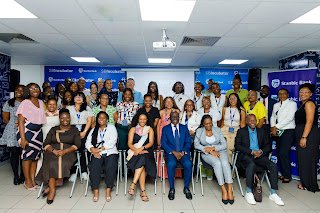
    Stanbic Bank Executives with the participants of the immersion programme
    organised by  Insurance Sector Education
    and Training Authority (INSETA) in partnership with the Gordon Institute of
    Business Science (GIBS)

  • Beneath the Trees: A Promise for Tomorrow

    Beneath the Trees: A Promise for Tomorrow


    Have you
    ever paused beneath a tree on a scorching afternoon, letting the shade wash
    over you? That quiet moment of relief is just the beginning of what trees give
    us. Beyond the shade, beyond the rustling leaves, trees are quietly doing
    something remarkable, absorbing the very gases that are warming our planet.

    Trees
    are carbon sinks. Through photosynthesis, they pull carbon dioxide from the
    atmosphere and lock it away. Why does that matter? Because carbon dioxide
    accounts for approximately 75% of global greenhouse gas emissions and can
    linger in the atmosphere for hundreds, sometimes thousands, of years. That is
    not a small problem. That is a generational one.

    Several
    greenhouse gases drive global warming: methane, nitrous oxide, fluorinated
    gases, and carbon dioxide, the most widely emitted of them all. Together, they
    are disrupting weather patterns, threatening ecosystems, and placing enormous
    pressure on the natural systems we depend on daily.

    Here is
    how it works. The sun sends energy toward Earth. Under normal conditions, some
    of that energy warms the planet while the rest reflects back into space. But
    greenhouse gases trap the outgoing heat, forming an insulating layer around the
    Earth, the greenhouse effect.

    The more
    gases we emit, the thicker that layer becomes, and the more heat gets locked
    in. The consequences ripple outward: rising temperatures, erratic rainfall,
    intensifying floods, and shrinking biodiversity.

    The
    trajectory is concerning. But it is not irreversible, at least, not yet.

    What Can We Actually Do?

    Scientists
    and engineers are developing carbon capture technologies to support natural
    processes, and those innovations matter. But there is also a solution available
    to every single one of us, right now: planting and protecting trees.

    It
    sounds almost too simple. But incremental actions build meaningful change.
    Every tree planted contributes to the global goal of net-zero emissions by 2050,
    balancing the greenhouse gases we emit with the amount we remove, and limiting
    global temperature rise to 1.5°C above pre-industrial levels. That target is
    what stands between manageable climate change and catastrophic disruption.

    Around
    the world, countries and organizations are responding, shifting to cleaner
    energy, investing in electric vehicles, adopting solar power, and building
    sustainability into policy. The momentum is real. The question is whether we
    will add to it.

    A Story That Changed How I See Things

    One warm
    Saturday afternoon, I was walking my puppy, Silver, when I noticed a woman in
    her yard, carefully planting seedlings. Her movements were deliberate, unhurried,
    purposeful. On the porch nearby, a young boy sat wrapped in a blanket, clearly
    unwell, watching her quietly.

    I asked
    why she had brought him outside rather than letting him rest indoors. She
    smiled and said, “I know he should be
    resting. But I want him to watch me. I could be shopping, solving a crossword,
    or eating chocolate with him those things are certain. A tree’s survival
    depends on so much beyond our control.”

    She
    paused, then added “But does that really
    matter? I want him to see my patience, my sacrifice, my love. One day, if he
    faces a decision about cutting down a tree, I hope he’ll remember this moment
    and choose differently.”

    She was
    not just planting trees. She was planting values. She knew she might never see
    these trees fully grown. But the possibility alone gave her joy. “If I didn’t act, there would be no chance
    at all.”

    Walking
    away, two words came back to me a saying often attributed to Chief Seattle, “We do not inherit the Earth from our
    ancestors; we borrow it from our children.”
    Something in me shifted that
    afternoon. It has not shifted back.

    Standard Bank Group Steps Up

    That
    spirit of intentional action is exactly what drives Standard Bank Group’s
    global tree-planting initiative this Earth Day. Across its countries of
    operation, the Group has launched the Blue Roots Project, in line with Stanbic
    Bank Ghana’s Blue Goes Green initiative, a commitment to reduce carbon emissions
    and restoring biodiversity, one tree at a time.

    Earth
    Day, observed every April 22, is a global movement confronting deforestation,
    pollution, and climate change. It turns awareness into action and this year,
    Stanbic Bank Ghana is proud to be part of it.

    Our
    sustainability targets in Ghana are bold: 500,000 seedlings planted by 2030
    with a 75% survival rate, a framework toward one million trees, and a carbon
    offset about 20% of our total emissions. This is not ceremonial. It is a
    commitment.

    Our
    purpose at Stanbic Bank Ghana is clear: Ghana is our home; we drive its growth
    through innovative solutions. That growth must be sustainable. It must account
    for the air we breathe, the climate we pass on, and the communities we serve.
    Environmental responsibility is not separate from what we do; it is central to
    it.

    One Question Before You Go

    Chief
    Seattle once warned, “Only when the last
    tree has died and the last river has been poisoned will we realize we cannot
    eat money.”
    Sobering words worth sitting with.

    So here
    is a thought to take with you today: if you had the opportunity to plant your
    first tree, where would you plant it and how would you make sure it thrives in
    your absence?

    Every
    tree planted today is a quiet promise to tomorrow. And when we stand together,
    our planet has a future.

    Happy
    Earth Day.


    Francis Ayisi,
    Head, Sustainability, Stanbic Bank Ghana

  • Stanbic Bank Urges Women Entrepreneurs to Leverage Social Media for Business Growth

    Stanbic Bank Urges Women Entrepreneurs to Leverage Social Media for Business Growth


    Women-led
    businesses in Ghana are being encouraged to move beyond passive online activity
    and strategically use social media as a critical tool for growth, visibility
    and access to finance.

    This
    call was made by the Head of Women Banking at Stanbic Bank Ghana, Marian
    Amartey, during the MTN SME Accelerate Webinar Series, where she spoke on the
    topic, “Breaking Barriers to Growth for Women in Business.” Her remarks
    highlighted a growing gap between the potential of women-owned enterprises and
    their ability to position themselves effectively in an increasingly digital
    business environment.

    According
    to her, while many women entrepreneurs are active on social media platforms,
    few are fully utilizing these tools to build credible business profiles that
    can attract customers, partners and even financial institutions.

    “Social
    media presence is no longer optional; it plays a key role in validating what
    you do as a business. Sometimes, before engaging you, financial institutions
    will check your online footprint. If you are not visible or intentional about
    your presence, you limit the information available for decision-making.”

    Her
    comments come at a time when small and medium-sized enterprises (SMEs),
    particularly in sectors such as trade, agribusiness and light manufacturing,
    are increasingly relying on digital platforms to reach wider markets. Yet, many
    women entrepreneurs, she observed, still treat social media as a casual posting
    space rather than a strategic business tool.

    Madam
    Amartey stressed that simply posting content without consistency or direction
    is insufficient. Instead, she encouraged women to adopt a more structured
    approach, one that includes showcasing products professionally, engaging
    audiences, and using built-in promotional tools to drive visibility.

    “Posting
    and going to sleep is not enough. These platforms have tools that can help you
    promote your work effectively. You need to be deliberate about how you present
    your business.”

    Beyond
    visibility, she pointed to partnerships as a key enabler of strong digital
    presence. Recognizing that many entrepreneurs juggle multiple responsibilities,
    from running their businesses to managing family and social commitments, she
    advised them to delegate certain functions to professionals.

    “You
    cannot do everything alone. Focus on your core business, whether it is food
    production, fashion or services, and bring in people who can help you build
    your brand online. That collaboration can significantly improve how quickly you
    grow.”

    This
    approach, she argued, not only enhances market reach but also positions
    businesses to take advantage of larger opportunities, including corporate
    contracts and supply chain partnerships. Without visibility, even high-quality
    products risk remaining unnoticed.

    Madam
    Amartey further noted that many women enter business based on skill or
    opportunity but often overlook the importance of systems and structures that
    make them “bankable.”

    “Visibility
    alone is not enough; you must back it with structure and clarity. Financial
    records, growth plans, and clear revenue streams are essential. Social media
    can open doors, but your internal systems will determine whether you can walk
    through them.”

    Her
    remarks also addressed a persistent perception gap that discourages some women
    from engaging with banks. She described this hesitation as largely unfounded,
    emphasizing that financial institutions are increasingly designing tailored
    solutions to support women entrepreneurs.

    “There
    is a perception that banks are difficult to approach, but that is changing. We
    have dedicated programs to build capacity, offer advisory services and prepare
    women-owned businesses for financing,” she stated.

    She
    further highlighted initiatives such as Stanbic Bank’s Business Incubator
    programs, which provide training and mentorship to help entrepreneurs
    strengthen both their operational and digital capabilities before seeking
    funding.

    With
    women representing one of the fastest-growing segments of Ghana’s
    entrepreneurial landscape, Madam Amartey urged them to take proactive steps to
    position themselves for growth. “This is a strong and expanding segment of the
    economy. Opportunities exist, but you must step forward, be visible and be ready.”

    Marian
    Amartey, Head, Women’s Banking, Business and Commercial Banking, Stanbic Bank
    Ghana