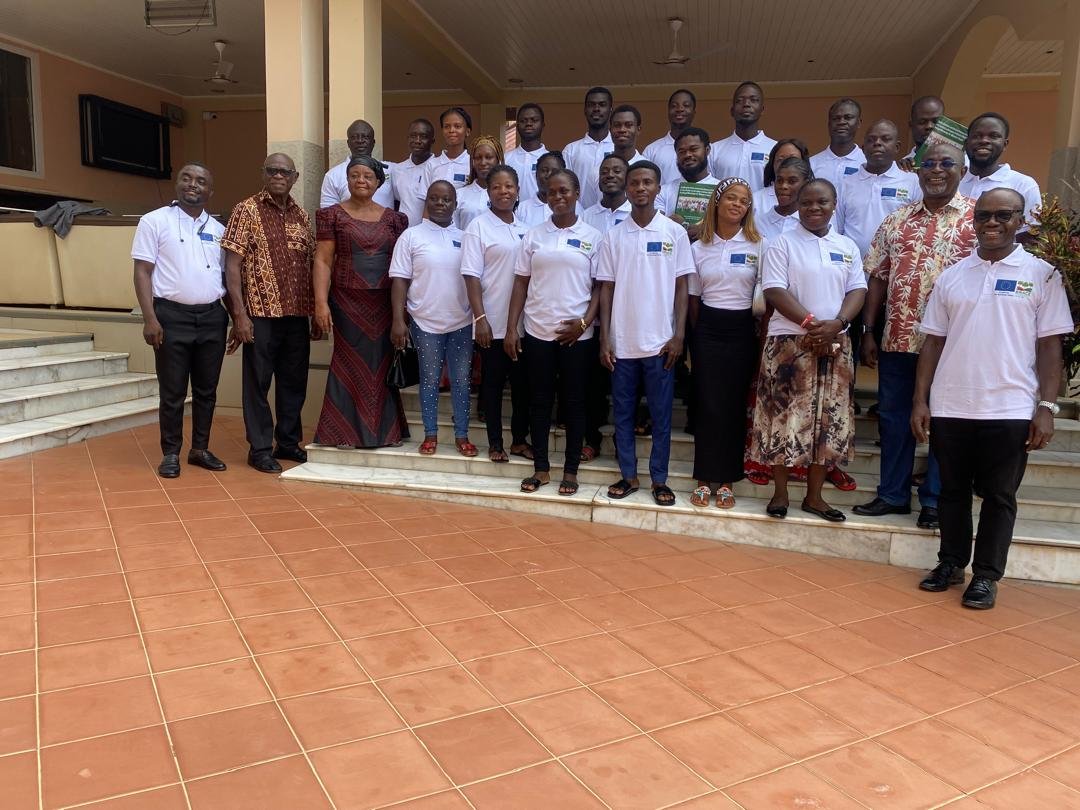
Paralegals Warned on Safety at EU-BRACE Workshop
A stark warning on personal safety has emerged from a paralegal training workshop in Kumasi, Ashanti Region as twenty-eight (28) community representatives were cautioned that gathering evidence at illegal mining site, including openly taking photographs, could expose them to serious risk.
The three-day workshop, held from 15th to 17th June, 2026, at Camp Martin Hotel, Kumasi was organised by Wacam in collaboration with A Rocha Ghana and the Nature and Development Foundation (NDF) under the European Union-funded BRACE Project.
The training brought together 10 women and 18 men from mining-affected communities across Ghana to serve as community-based “focal persons” equipped with legal knowledge to address environmental degradation, human rights violations and socio-economic injustices linked to mining activities.
The Safety Warning
Dr. Edgar Takyi Akonor of the University of Cape Coast, who facilitated sessions on advocacy and communication strategies, led discussions that highlighted practical challenges associated with advocacy and human rights monitoring. One participant observed that advocates and paralegals must exercise discretion and good judgement when gathering evidence, noting that “it may not always be safe to openly take photographs at mining or illegal mining sites.”
The discussion emphasised the need for advocates to prioritise their personal safety while carrying out monitoring and documentation activities — a warning that underscored the real-world dangers facing community volunteers operating in areas controlled by illegal mining networks.
Welcome Address
The Executive Director of Wacam, Daniel Owusu-Koranteng, welcomed participants and encouraged them to take the training seriously. He urged them not only to apply the knowledge and skills acquired for their personal benefit but also to use them to support and empower their respective communities. He reiterated Wacam’s commitment to empowering mining-affected communities through capacity-building initiatives.
The Technical Director of Wacam, Kwaku Afari, opened the programme by providing participants with background on Wacam’s advocacy efforts in mining-affected communities across Ghana. He outlined the training objectives and divided participants into four groups to facilitate discussions, case studies and group exercises throughout the workshop.
Human Rights and Free Prior and Informed Consent
Mr. Afari facilitated sessions on fundamental human rights and the operationalisation of Free Prior and Informed Consent (FPIC) in mining communities. The human rights session introduced participants to the concept of rights as entitlements necessary for living a dignified life, examining characteristics including universality, equality, non-discrimination, indivisibility and inalienability. The session explored civil and political rights, economic, social and cultural rights and collective rights such as the rights to development, participation and a healthy environment.
The FPIC session focused on the right of communities to receive adequate information and participate meaningfully in decisions affecting their lands, resources, and livelihoods. Participants were introduced to the principles of “free,” “prior,” “informed,” and “consent,” with discussions examining international, regional and national frameworks supporting FPIC and highlighting the importance of community participation, transparency, accountability and access to information in natural resource governance.
Mining and Community Development
The Associate Executive Director of Wacam, Hannah Owusu-Koranteng, facilitated a session on Mining and Community Development examining the relationship between natural resource exploitation, environmental sustainability and socio-economic development. Participants discussed the importance of balancing economic growth with environmental protection, social justice and community wellbeing.
The session highlighted the importance of ecosystems and environmental services including water purification, biodiversity conservation, climate regulation, food production and soil fertility. Participants were taken through the environmental and social impacts of irresponsible mining activities, including forest degradation, water pollution, loss of biodiversity, destruction of livelihoods and threats to public health.
Following the presentation, participants reflected on practical measures that communities could adopt to address mining-related challenges. One participant emphasised the responsibility of paralegals to educate community members on the adverse effects of mining activities and the need to protect community rights and natural resources. Another participant suggested that chiefs and religious leaders should be included in similar training programmes. In response, Mrs Owusu-Koranteng noted that Wacam had engaged traditional authorities on mining-related issues over many years and stressed the importance of broad-based community participation in promoting accountability and environmental justice.
Legal Framework and Access to Justice
The Executive Director of the Centre for Public Interest Law (CEPIL), Augustine Niber, facilitated comprehensive sessions on the Minerals and Mining Act, 2006 (Act 703), and related regulations. Participants were taken through key provisions including mineral rights, compulsory acquisition of land, compensation, resettlement, surface rights, royalties and the rights of affected communities under Ghana’s mining laws. Particular emphasis was placed on compensation procedures, resettlement requirements and the responsibilities of mining companies and state institutions toward affected persons and communities.
Mr. Niber also introduced participants to the role of paralegals as community-based resource persons equipped with basic legal knowledge and practical skills to assist communities in addressing rights violations and injustices. The session highlighted paralegal responsibilities including public education, human rights monitoring, documentation of cases, dispute resolution, networking, advocacy and serving as a link between communities and legal institutions.
The human rights monitoring session focused on principles and processes including information gathering, investigations, interviewing, reporting, confidentiality, objectivity, accuracy and the importance of proper documentation in supporting justice and accountability efforts. Mr. Niber further facilitated a session on access to justice, introducing participants to avenues for seeking redress including the courts, CHRAJ and alternative dispute resolution mechanisms. Common barriers to justice such as poverty, limited legal awareness, distance, delays and the high cost of legal services were discussed.
Advocacy and Communication
Dr. Edgar Takyi Akonor’s session on effective advocacy and communication strategies introduced participants to the concepts of advocacy and communication and their importance in promoting responsible mining practices and protecting community interests. He used the example of a Methodist Church member who publicly challenged church leaders over tithing and accountability to demonstrate the importance of effective communication, transparency and constructive engagement.
Participants were taken through the qualities required of effective advocates, including integrity, technical knowledge, communication skills, resilience, adaptability and networking abilities. The presentation explored key elements of effective communication including defining objectives, understanding target audiences, developing clear messages, selecting appropriate communication channels and encouraging dialogue and feedback. Participants were also introduced to advocacy strategies such as stakeholder analysis, coalition building, policy engagement, public awareness campaigns, lobbying, research and community mobilisation.
Workshop Outcomes
The workshop included practical group work and case study exercises through which participants analysed issues relating to mining operations, human rights, compensation, access to justice, community participation and environmental protection. The exercises enabled participants to apply lessons learned during the workshop and share experiences from their respective communities.
The workshop contributed significantly to strengthening participants’ capacity to engage effectively with mining companies, government institutions, and other stakeholders. Participants enhanced their understanding of fundamental human rights, mining laws, access to justice mechanisms, advocacy strategies, communication approaches and community engagement processes. The training improved participants’ ability to monitor and document environmental and human rights violations, organise community members around common concerns and advocate for accountability and responsible mining practices.
The workshop represents an important step toward strengthening community participation in mineral resource governance and advancing the protection of community rights in Ghana’s extractive sector.