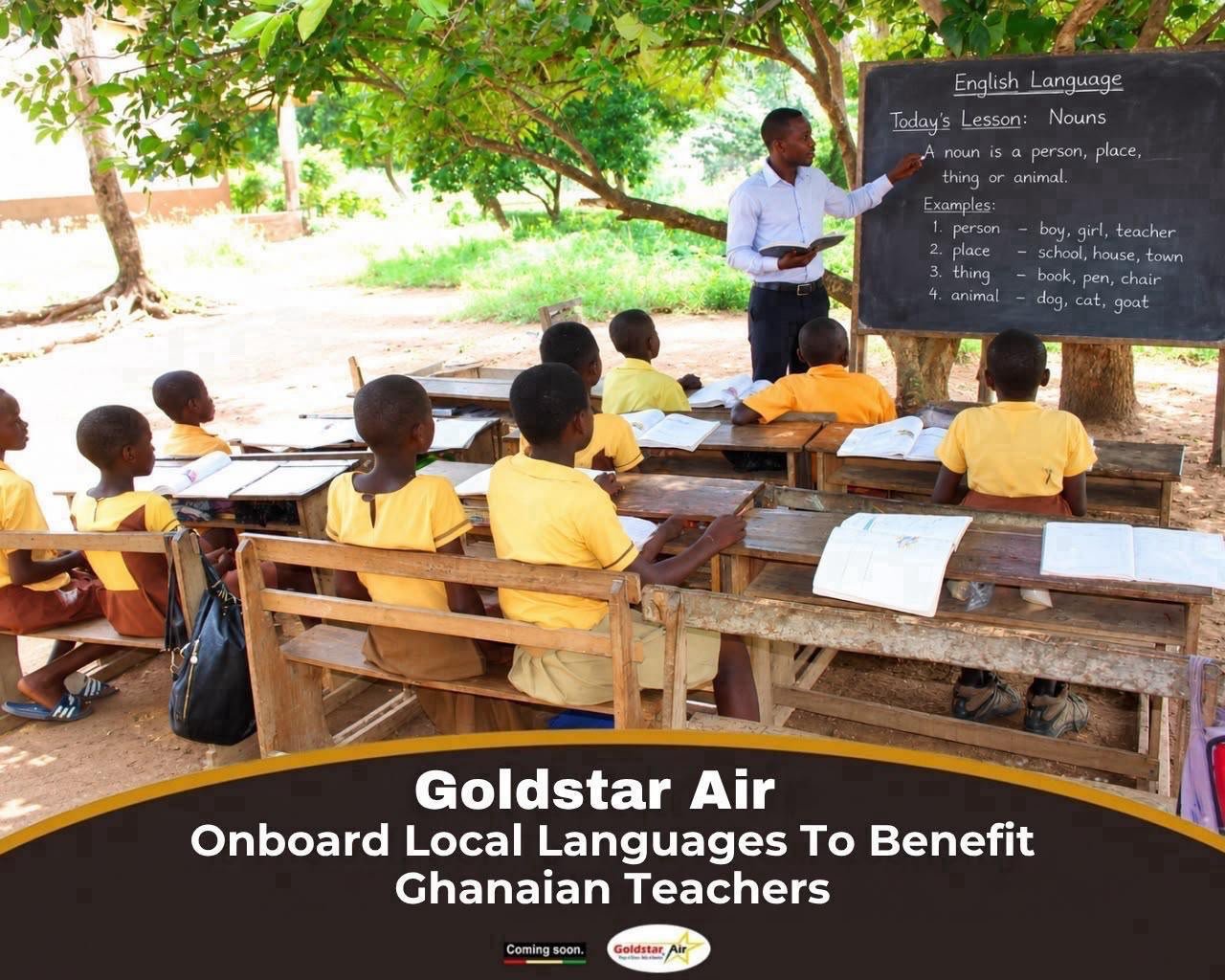
Goldstar Air Onboard Local Languages To Benefit Ghanaian Teachers
Dependable airline Goldstar Air is set to launch an innovative initiative that will provide well-paying jobs for Ghanaian local-language teachers as cabin crew. This initiative forms part of the airline’s broader employment opportunities to create over two million direct and indirect jobs for Ghanaians. Goldstar Air will welcome passengers with five key local languages; Ewe, Akan, Hausa, Ga-Dangme, and Dagbani, in addition to English, the official language used on all flights to and from every destination and on the ground. French and Arabic will also be used where necessary. The airline will enable Ghanaians to welcome the world without leaving their own voices behind, while also creating opportunities that connect language learners and teachers. This initiative is also a declaration that Ghanaian linguistic heritage will occupy a respected place in international aviation, global tourism, modern commerce, education, and national development. Goldstar Air will connect local-language teaching to diaspora engagement, creative arts, trade, and global communication, and help make language teaching not merely a school subject but a pathway into a wider economy of culture, learning, service, and international connection.
Goldstar Air will provide comprehensive cabin crew training for the teachers to complement their existing skills and prepare them for successful careers in aviation, subject to each candidate satisfying all applicable aviation, medical, regulatory, and employment requirements. For Ghanaian teachers, this initiative will create demand for their services as translators, language consultants, voice artists, curriculum developers, cultural advisers, digital instructors, pronunciation coaches, content reviewers, researchers, customer-service trainers, and ambassadors of Ghanaian identity. Teachers of local languages have long carried responsibilities that go far beyond the classroom. They preserve vocabulary, oral traditions, pronunciation, history, proverbs, songs, storytelling, values, and identity. They help children understand where they come from. They teach learners that intelligence is not limited to the language of formal administration but can be expressed through the rich languages spoken in homes, markets, villages, towns, workplaces, traditional councils, churches, mosques, festivals, and family conversations across Ghana. Yet, despite the importance of their work, many local-language teachers have not always received recognition, professional pathways, resources, and economic opportunities commensurate with the value they bring to the nation.
The United States- and Ghanaian registered company Goldstar Air, with an issued Air Carrier Licence (ACL/N-SCH No. 0239) from the Ghana Civil Aviation Authority (GCAA) to operate passenger and cargo services across West Africa and to intercontinental destinations, initiative extends far beyond aviation. The airline aims to become a catalyst for economic transformation by creating sustainable employment opportunities that address the root causes of poverty, reduce youth unemployment, strengthen industrial growth, expand tourism, facilitate international trade, promote agricultural exports, and contribute significantly to Ghana’s long-term economic resilience. Therefore, the Director-General of the Ghana Civil Aviation Authority, Rev. Stephen Wilfred Arthur, must do the needful by tasking the Safety Department to get a qualified third party to finalise Goldstar Air’s wide-body aircraft Safety Certification (AOC) process immediately, for which an administrative fee will be charged to the airline, and Goldstar Air is ready and willing to pay it.
The Head Pastor of Kingdom Family International Church at Abeka Lapaz and Director-General of the Ghana Civil Aviation Authority, Rev. Stephen Wilfred Arthur, must understand that it is essential for the director-general of any organisation to step aside when continued leadership compromises organisational integrity, performance, or strategic alignment. Therefore, the persistent failure of Rev. Stephen Wilfred Arthur to instruct the Safety Department to engage a third party to finalise Goldstar Air’s Safety Certification process signals a need for new leadership and a normalisation team. The issue of inviting a third party for a meeting can be resolved efficiently in just 20 minutes, with all parties reaching agreement on the timing and performance schedule (Schedule of Events) for the final certification process, to set Ghana free forever. The completion of Goldstar Air’s Safety Certification will enable the change of the airline’s wide-body aircraft nationality, allowing it to be registered under the Ghana Aircraft Registry (State of Registry), thereby enhancing Ghana’s broader aviation reputation and for the airline to achieve its Project $1 Trillion Foreign Reserve Goal.
The Director-General of the Ghana Civil Aviation Authority, Rev. Stephen Wilfred Arthur, is fully aware of the airline’s Safety Certificate situation. The prevalence of nepotism and cronyism, including selective retirement ages within the Ghana Civil Aviation Authority, leads to corruption, wasting taxpayers’ money, wilfully causing financial loss to the state, and sabotaging the government’s efforts of the Resetting Ghana agenda to a New Economy, ultimately hindering the nation’s progress. The alleged attempted sabotage of Accra Airport safety equipment, which is critical to aircraft communication, navigation, and safe operations, during a planned strike by some Ghana Civil Aviation Authority employees between 11:30 p.m. on January 14 and 4:30 a.m. on January 15, 2026, was reportedly foiled by National Security officers is part of a grand scheme and a common practice as a means of intimidate any government that comes into power. The Director-General of the GCAA must understand that any prolonged delay in Goldstar Air’s Safety Certification process represents an appalling injustice that has ruined lives, caused irreparable harm, disconnected people from God, and a crime against humanity. He should remember that his church’s passion is to obey God, expand His Kingdom, and transform lives on earth through a dedicated life of holiness, worship, and love.
The importance of Goldstar Air’s initiative to employ local-language teachers on board lies in a simple truth: language is not a barrier to development; it is an asset for development. Every language carries knowledge, memory, humour, wisdom, hospitality, social values, agricultural understanding, family ties, spiritual expression, and community identity. When a country treats its languages with respect, it strengthens the confidence of its people. When a company with international ambition brings those languages into a global environment, it sends a powerful signal that cultural pride and commercial excellence can move together.
The airline’s initiative will therefore be seen as a bridge between the classroom and the skies. It will connect teachers standing before pupils in local schools with passengers travelling across continents. It will connect a language lesson in Tamale, Kumasi, Ho, Accra, Koforidua, Cape Coast, Wa, Bolgatanga, or Keta with a Ghanaian child growing up in London, New York, Toronto, Baltimore, Washington, Dubai, Lagos, Abidjan, Johannesburg, or elsewhere in the world. It will connect traditional knowledge with digital learning, cultural preservation with job creation, and Ghanaians’ past with a more globally confident future.
Goldstar Air’s decision to incorporate local languages on board has deep symbolic meaning because an aircraft is one of the most visible expressions of a nation’s international presence. Goldstar Air’s aircraft will not remain in one community. They will move across borders, continents, time zones, business centres, tourism destinations, and cultural spaces. They will carry people who may never have visited Ghana, Ghanaians returning home, members of the diaspora reconnecting with their heritage, business people, students, tourists, professionals, artists, investors, families, and dreamers. When Goldstar Air’s aircraft welcome passengers in Ghanaian languages, they will transform each journey into an encounter with the nation.
Passengers will be welcome with “Akwaaba” in Akan, “Obaake” in Ga-Dangme, “Woezor” in Ewe, “Sannu da zuwa” in Hausa, “Maraaba” in Dagbani, or another Ghanaian language is to receive more than information; it is to receive recognition. It will tell passengers that Ghanaian identity is present in the experience. It will tell Ghanaian travellers that their mother tongue is not something to be hidden once they enter an international environment. It will tell foreign visitors that Ghana is a country with living cultures and proud communities. It will tell Ghanaian children born abroad that the language spoken by their grandparents is worthy of being heard in the skies. This is where Ghanaian teachers will become central to the initiative. A language cannot be used professionally without people who understand it deeply. A language cannot be translated accurately without experts who know its grammar, idioms, cultural context, pronunciation, registers of formality, and changing usage. A language cannot be taught effectively online without trained teachers who can organise content, guide learners, correct misunderstandings, create engaging lessons, and make language feel alive. Goldstar Air’s initiative will create a need for precisely these kinds of professionals.
Goldstar Air, “the wings of Ghana and the belly of America” will focus on leveraging Ghana’s position as the centre of the world and the gateway to Africa to drive strong revenue performance. This growth will also be supported by the airline’s continued strength in the demand environment. In-flight entertainment systems featuring multilingual options, such as Kumawood films and Highlife and Hiplife music, will ensure that passengers feel welcome and at ease during their flights. Ghana’s music and film industries will benefit from growing demand within the global in-flight entertainment market, which is influenced by the rising number of air passengers worldwide, including through the promotion of Kumawood films. This forms part of Goldstar Air’s job-creation drive, which aims to create over two million direct and indirect job opportunities for Ghanaians. Older Kumawood films, Highlife music, and Ghanaian gospel music will form part of the airline’s onboard entertainment, giving passengers a variety of films and music videos to watch and listen to. This initiative will provide additional value to producers by generating extra revenue from older works that may have received limited commercial opportunities after many years of production. The airline will also use the platform to honour living legends in recognition of their outstanding contributions to Ghana’s creative industries.
The airline will assist employees in acquiring homes of their choice through Goldstar Air’s strategic home-mortgage scheme. Goldstar Air has signed strategic mortgage agreements with two companies to facilitate employee home ownership as part of the benefits its offering to employees. These opportunities will support employees in implementing the airline’s innovative 24-hour solutions. Goldstar Air will create a more equitable company in which every employee will live with dignity and security and own a dream home after completing school and securing well-paying employment.
Goldstar Air’s strategic mortgage agreements will allow the airline to assist employees who wish to own homes of their choice by providing the necessary guarantees to enable them to acquire their real estate properties. Employees must accept to facilitate the payment of monthly instalments for their properties through deductions from their salaries. This benefit will help them complete payments on time, giving them peace of mind and allowing them to consider other lifetime needs. Younger employees who may need help saving for a home in today’s market will find solutions through Goldstar Air’s employment drive. Employees will be able to avoid the upfront down payment normally associated with mortgages and instead use their monthly income to support home ownership, with matching contributions.
The State Housing Company Limited’s (SHC) decision to sell homes at prices starting from GH¢950,000 has sparked online debate, with the cost drawing attention to the challenges many Ghanaians face in owning a home. The company has opened sales of two-, three-, and four-bedroom houses under its Surge Homes project at Amrahia in the Greater Accra Region, where it is developing 195 residential units. The prices have prompted questions about whether the houses are within reach of ordinary workers and families, particularly at a time when raising the money needed to purchase a home remains a major challenge for many Ghanaians. The prices have also renewed attention to the gap between housing costs and what ordinary workers can afford, especially those who rely on monthly salaries and may struggle to save enough for a mortgage deposit or an outright purchase. Goldstar Air will help its employees buy homes through Employer-Assisted Housing (EAH) programmes.
Ghana’s President, His Excellency John Dramani Mahama, has set March 2027 as the target date for the completion and commissioning of the first 700 housing units under the revived Saglemi Housing Project, while a total of 1,500 units under the initial phase are expected to be completed by December 2027. The President gave this assurance on Thursday, August 20, 2026, after inspecting ongoing redevelopment works at the Saglemi site, where the government is working with the private sector to revive the long-delayed housing project. The Saglemi project, originally designed as a 5,000-unit affordable-housing development, has remained largely incomplete for several years following a series of challenges that halted construction. President Mahama said that the current arrangement with LMI Group is intended to ensure that work resumes in earnest and that the estate is eventually transformed into a functional residential community for Ghanaian families. President Mahama urged prospective homeowners to take advantage of the opportunity when the sales process begins. Goldstar Air is looking forward to purchasing several units for its staff members.
The starting basic pay for a newly trained public-school teacher under the Ghana Education Service (GES) is approximately GH¢2,200 (Diploma) to GH¢3,100 per month and is governed by the Single Spine Salary Structure. Some unregulated private schools often pay much less. The minimum pay for starting teachers in private basic schools can drop as low as GH¢600 to GH¢1,000 per month, and sometimes even lower for informal or pupil teachers. Government-employed teachers receive standard public-sector allowances and regularised pay, whereas pay in private schools depends entirely on individual school owners and locations. Ghana’s national daily minimum wage of GH¢21.77, effective January 1, 2026, is under US$2 per day. Although even low-end private-school pay may technically exceed the legal national minimum, it often fails to match rising living costs. Ghanaian local-language teachers serving on Goldstar Air’s 24-hour onboard service will be paid biweekly, meaning every two weeks. Their pay will follow the same frequency as the salary structure at other destinations, helping to avoid employment discrimination. This will be the first arrangement of its kind in Ghana’s aviation sector.
According to the Chairman and Chief Executive Officer of Goldstar Air, Eric Bannerman, the airline’s special onboard local language initiative will also focus on discounted child fares for Ghanaian families in the diaspora. This initiative, named “Home Sweet Home,” will allow them to bring their children to visit Ghana at least twice a year. The goal is to encourage these children to consider acquiring Ghanaian citizenship and to foster a strong connection with the country. By making Ghana more attractive to them, the initiative will enable them to collaborate more significantly with their local communities, thereby boosting development and Gross Domestic Product in the future for a better Ghana. Additionally, this experience will help children develop greater empathy for cultural differences, enhance their adaptability to changing environments, and shape their linguistic development.
Travel has the potential to teach children about their similarities with others and to lay a strong foundation, especially in their early years. Exposing children to travel and education in their native languages while reinforcing their roles as global citizens helps ensure that they carry these values into adulthood. When a habit or tradition is instilled early in life, it becomes the lens through which individuals perceive and interact with the world for the rest of their lives. Second-language skills are of above-average importance to Goldstar Air, particularly for flight attendants. Many airlines now require bilingualism as part of their recruitment criteria. Within an international cabin crew, employees often speak different languages and dialects, making multilingual proficiency a valuable asset.
The Ga-Dangme language will be prominently featured both on the ground and on board the airline’s aircraft. Ga-Dangme, a combination of two closely related languages, Ga and Dangme, shares similarities in basic vocabulary and is spoken not only in Ghana but also in Togo, Benin, and western Nigeria. Integrating the Akan language on board the airline will foster significant growth opportunities and economic benefits. Akan, the most widely spoken language in Kumasi, serves as the principal language of the Ashanti people, who form the majority of the city’s population. Akan has two main dialects, Twi and Fante, reflecting its linguistic diversity.
Goldstar Air’s commitment to championing the inclusion of the Ghanaian local languages onboard its aircraft, the Ewe language will also feature prominently. It is spoken across Ghana, Togo, and Benin, with traces of the language found in western Nigeria. Ewe has dialects such as Anglo, Tongu, Vedome, Gbi, and Krepi, all of which share remarkable similarities. The Dagbani language, widely spoken in northern Ghana, is one of the languages that will also be introduced on board. The Dagbani, Nanumba, and Mamprusi languages of the Northern Region are closely related and mutually intelligible with the Frafra and Waali languages of Ghana’s Upper East and Upper West Regions. The airline will also be introducing Hausa language on board, which is one of Africa’s most widely spoken languages, ranking after Arabic, French, English, Portuguese, and Swahili. It serves as both a lingua franca and a trade language in West Africa. Hausa is spoken in Ghana, Benin, Burkina Faso, Cameroon, the Central African Republic, Chad, Congo, Eritrea, Germany, Niger, Sudan, and Togo.
The use of Dagbani and Hausa on board is of significant importance to business operations in northern Ghana. With the Tamale International Airport serving as a pivotal hub for Goldstar Air’s maintenance and training operations. Preparations are underway to operate international passenger and cargo flights to and from the Sahel region, as well as Hajj flights to Mecca, these languages will be instrumental.
Goldstar Air’s local-language initiative will help change how pupils view Ghanaian-language subjects. Too often, students may assume that local-language study is less important than English, science, mathematics, technology, or business. These subjects are all important, but language should not be treated as their opposite. Language is the foundation through which children understand ideas, communicate knowledge, build relationships, and express identity. A student who sees local-language teachers participating in aviation, digital education, tourism, translation, and international cultural exchange will recognise that local-language learning can lead to meaningful careers.
The airline will therefore become a source of inspiration for young people. A pupil in a village school will one day hear a Ghanaian language used on an international flight and think, “My language can travel.” A young girl may decide to become a language teacher, translator, voice artist, or cultural researcher. A young man may begin learning both his mother tongue and a foreign language because he sees possibilities in tourism and international business. A student may develop an interest in software, digital education, or media production because local languages are being brought into modern platforms. Inspiration does not solve every challenge, but it can change the direction of a life.
Goldstar Air’s Ghanaian-language cabin crew members will help shape passenger announcements. They will ensure that welcome messages sound warm, respectful, and natural rather than mechanical or poorly translated. They will advise on pronunciation and help determine the right expressions for greetings, safety-related customer communication, cultural information, meal descriptions, destination messaging, entertainment content, and special announcements. They will ensure that local language content respects the speakers of each language and reflects the dignity of Ghana’s linguistic communities.
The opportunity will extend beyond announcements. Goldstar Air will develop in-flight language content that will introduce passengers to basic greetings, useful expressions, common proverbs, cultural explanations, place names, songs, stories, and heritage. Ghanaian teachers will create and review this content. A short in-flight segment will teach a visitor how to greet a host in Akan, say thank you in Ewe, welcome a traveller in Ga-Dangme, or show appreciation for hospitality in Dagbani. These small moments will make Goldstar Air’s flights memorable. The airline’s cabin crew will make visitors feel more connected before they land.
The airline’s initiative will make travellers from diaspora communities feel more at home by offering local languages, food, and drinks. Ghana’s diaspora includes many children and young adults who know that their roots are Ghanaian but may not speak the language of their parents or grandparents confidently. Some understand a little Akan, Ewe, Ga, Dagbani, Hausa, Fante, Nzema, Dagaare, Gonja, Kasem, Gurene, or another Ghanaian language but struggle to speak it. Some feel embarrassed when relatives address them in a language they cannot answer. Some want to learn but do not know where to begin. Others live in communities where formal Ghanaian language classes are difficult to find.
Goldstar Air will help create a bridge for these learners. Its connection with diaspora routes, international travellers, and Ghanaian communities abroad will support an educational initiative that will make local-language learning more accessible. Ghanaian teachers will become the heart of that initiative. They can teach online classes, design age-appropriate lessons, record pronunciation guides, create story-based learning materials, host conversation sessions, and build communities of learners. This initiative will create new income streams for teachers while giving diaspora families a stronger connection to Ghana.
The airline’s opportunity will be transformational for many teachers. Teachers who currently depend solely on classroom income can also become online tutors. A teacher with a gift for storytelling can create digital lessons for children. A teacher with research interests can develop language guides for tourists and business travellers. A teacher with strong media skills can host a language programme. A teacher who understands both a Ghanaian language and English, French, Arabic, or another international language can support translation and cross-cultural communication. The profession will expand beyond the physical classroom into a wider international marketplace. This does not mean that teachers should abandon schools. On the contrary, it means that the value of school-based teaching will be recognised more fully. The foundational work done in Ghanaian classrooms will create the language knowledge that makes future opportunities possible. When pupils learn their local language well, they gain a stronger sense of identity and a deeper understanding of their community. They learn that their language can be used in education, business, technology, media, tourism, and international engagement. They begin to see language study as a skill with real-world value.
Goldstar Air, “the Belly of America and Wings of Ghana,” has introduced a 24-hour service initiative called “Pocket Change for Smile” to help fund dialysis machines and address the issue of schools under trees. This initiative will raise funds through donations from passengers who contribute their spare coins, whether in foreign or local currency, to support the programme. The airline will encourage passengers to donate spare change from international travel into designated boxes located in airport lounges, at check-in counters, in departure waiting areas, and on board flights before arrival at their destinations. The airline’s commitment to Corporate Social Responsibility (CSR) through Pocket Change for Smile aims to distribute dialysis machines nationwide and help eliminate schools under trees, thereby improving healthcare services for kidney patients and educational conditions for school children in Ghana. It will also provide quality medical care for the airline’s retired employees suffering from kidney disease. Goldstar Air remains committed to improving lives and supporting its valued workforce.
The airline will collaborate with international organisations that share a similar vision, encouraging them to join the Pocket Change for Smile programme and reach people in need worldwide through this impactful initiative. Similar partnerships between UNICEF and various international airlines have already demonstrated the potential of such programmes. Since its launch, UNICEF’s Change for Good programme has generated over US$185 million, showcasing how airlines can engage travellers, raise awareness, demonstrate a shared commitment to social responsibility, and increase customer loyalty. As part of Goldstar Air’s Corporate Social Responsibility, the airline has donated building materials to Assin Brofoyedru M/A Basic School in the Assin Central Municipality of the Central Region. The donation is intended to help the school rehabilitate its Junior High School block, which collapsed some time ago as a result of heavy rainfall. The Assembly Member for Nyankomase/Brofoyedru, Bismark Obeng Donkoh, graced the occasion and received the items on behalf of the chiefs and elders.
Minister of Education Hon Haruna Iddrisu speaking on a morning radio show in Accra on March 12, 2025, revealed that approximately 5,000 schools across Ghana are still operating under trees, lacking proper infrastructure. He expressed concern over the existing infrastructure gaps, particularly in Junior High Schools, highlighting deficiencies in both physical and digital resources. The Minister questioned the quality of teaching materials, and blackboards they use. Hon Iddrisu lamented that, three decades after the 1992 constitution, Ghana has yet to achieve free compulsory universal basic education. He further stated that, there are about 759 schools that require urgent infrastructure intervention, in terms of schools under trees, and it is a shame for him. You still have the quality problem between the north and the south and between the rural and urban. He emphasized the need to correct these imbalances to ensure students acquire 21st Century competencies.
Mr Bannerman emphasised that the airline will create partnerships with teacher-training colleges, universities, language departments, the Bureau of Ghana Languages, cultural institutions, Ghana Education Service stakeholders, local-language associations, writers, broadcasters, and community leaders. These partnerships will help ensure that content is accurate, inclusive, and professionally developed. They will also provide teachers with opportunities for training in digital instruction, translation, voice recording, content development, hospitality communication, and intercultural competence. Goldstar Air will record voices, short documentaries, podcasts, in-flight features, digital archives, and storytelling programmes from across Ghana. A country that records its stories protects part of its future.
The Ghanaian-language teacher who has spent years teaching Akan in a school will have the knowledge needed to create a beginner course for international passengers. An Ewe teacher can develop cultural-orientation material for travellers visiting the Volta Region. A Dagbani teacher can create digital lessons for children of northern Ghanaian heritage living abroad. A Ga-Dangme teacher can contribute to Accra tourism content, local business communication, and heritage information. A Hausa teacher can support communication across regional and cross-border networks. Each teacher will become not only an educator but also a contributor to Ghana’s cultural economy.
Teachers can develop these experiences. They can write scripts, narrate stories, explain pronunciation, select proverbs and cultural examples, and work with filmmakers, musicians, animators, designers, and software developers. This will create a creative-production ecosystem around language. Teachers will become part of teams that include writers, editors, voice actors, translators, videographers, illustrators, sound engineers, digital designers, and cultural researchers. The local-language programme will thus support multiple professional fields. Teachers are often among the most respected people in their communities, yet their voices are not always heard in national conversations about culture, technology, tourism, and business. By working with educators, Goldstar Air will show that teachers are not outside economic development; they are central to it. They prepare the workforce, transmit culture, shape confidence, develop communication skills, and help young people understand both the world and themselves. Teachers must be fairly compensated.
Goldstar Air’s initiative represents a chance for Ghanaian teachers to move from being seen only as employees of schools to being recognised as custodians of national intellectual capital. Teachers know how to make unfamiliar ideas understandable. They know how to guide learners patiently, structure content, correct without humiliating, and motivate people who are afraid of making mistakes. These skills are valuable in many environments, including digital education, customer service, staff training, tourism interpretation, cultural orientation, public communication, and media production.
The cultural economy is an important part of national development. It includes music, film, fashion, food, art, literature, tourism, heritage, design, storytelling, media, festivals, and language. These sectors create value because people are willing to pay for meaningful experiences, products, knowledge, and connection. Ghana has immense cultural wealth, but this wealth must be organised, presented, protected, and shared professionally in order to create sustainable jobs. Local language teachers will also play a leading role in that process because they understand the meaning behind the culture.
The value of language education also extends into tourism. Visitors who understand even a few local phrases often have richer experiences. They can greet people respectfully, ask simple questions, and understand signs, songs, names, and cultural references more deeply. They will feel more connected to the places they visit. Local communities will feel more respected when visitors make an effort to engage. Teachers will create tourism language guides that make this possible.
Goldstar Air’s initiative will create jobs in communities because visitors who feel connected are more likely to explore beyond the airport and major hotels. They will visit local markets, cultural centres, heritage sites, restaurants, festivals, museums, craft villages, and community attractions. They will spend more time in the country, purchase locally made goods, and return with friends and family. Language will become part of the visitor experience, and the visitor experience will become part of local economic development.
The child who learns the language of their grandparents gains more than vocabulary. The child gains access to family stories and can speak more directly with older relatives. The child will understand humour, advice, prayers, songs, and expressions that do not translate easily into English. The child will feel less divided between life abroad and their heritage at home. Goldstar Air’s “Home Sweet Home” spirit will become meaningful through these kinds of connections. The local-language programme will also promote lifelong learning. Language is not only for children. Adults may want to improve fluency, recover a language they have lost, learn the language of a spouse or community, prepare for travel, understand cultural texts, or communicate with relatives. Goldstar Air will support local-language programmes for adults at different levels.
Imagine a passenger settling into a seat before departure and watching a short feature about Ghanaian greetings. The passenger learns not only how to say “welcome” but also why greeting matters in Ghanaian social life. The passenger learns that acknowledging people is part of showing respect. The passenger learns a phrase in a local language and arrives in Ghana prepared to connect more warmly with people. This small experience will change the quality of travel. It will turn a visitor from a distant observer into a more respectful participant in the culture.
Ghana, with its many linguistic communities, language inclusion must be handled with respect and balance. The choice to begin with five key languages does not mean that other Ghanaian languages are unimportant. Rather, it is a starting point for a larger vision of inclusion. Goldstar Air will build a rotating cultural and language programme that gives visibility to more languages over time. Teachers from different regions will contribute. Communities will feel represented. Passengers will learn that Ghana is not defined by one voice, but by many voices woven together into a national identity.
Goldstar Air’s professional approach will raise the status of local-language teaching. Too often, people assume that anyone who speaks a language can teach it. However, speaking a language and teaching it are not the same. A teacher understands how learners progress and the difference between listening, speaking, reading, and writing. A teacher understands the importance of practice, repetition, confidence, correction, and encouragement. A teacher also understands that children, adults, tourists, heritage learners, and business professionals need different methods. Goldstar Air’s use of local languages will strengthen the customer experience and help society recognise this expertise while creating work for teachers and language professionals. The airline’s initiative will become a meeting point between cultural pride and commercial intelligence.
This is the promise of the initiative: not simply that local languages will be heard on a flight, but that the people who teach those languages will be recognised as professionals with international relevance. The classroom can become a launchpad. The teacher can become a cultural entrepreneur. The language can become a source of connection, income, confidence, and national pride. Teachers will benefit more when society recognises that culture has economic value. A teacher who helps preserve a language is not only protecting the past; the teacher is preparing resources for tourism, media, education, technology, trade, diplomacy, and creative enterprise. The teacher is helping Ghana speak to itself and to the world, building a bridge between generations and creating a foundation for national confidence.
Goldstar Air’s decision to introduce local languages onboard will therefore benefit Ghanaian teachers by creating new roles, platforms, audiences, and respect for their expertise. It will help transform language education from a field too often overlooked into a pillar of cultural diplomacy, tourism development, digital learning, diaspora engagement, customer experience, and national branding. It will help Ghanaian teachers see that the lessons they teach today will one day be heard by passengers crossing oceans, children reconnecting with grandparents, visitors discovering Ghana, and learners around the world.
The future of Ghana depends not only on the infrastructure it builds, the industries it develops, or the markets it enters. It also depends on the confidence of its people in who they are. Ghanaian languages carry that confidence. They carry the memory of communities, the wisdom of elders, the creativity of artists, the dreams of children, and the everyday humanity of millions of people. Goldstar Air will give those languages a place in the skies and provide Ghanaian teachers with a wider stage on which to serve, teach, inspire, and build the nation.
The airline will build stronger connections with passengers by introducing a request line asking passengers when purchasing tickets to fill or tick a space to indicate or select the local dialect with which they are most comfortable. This information will be reflected on their boarding passes, helping the airline anticipate the number of passengers who speak a particular dialect. This will enable Goldstar Air to tailor communication, entertainment, and meal options to better serve its passengers.
Goldstar Air’s local-language initiative will always preserve aviation safety. English remains the internationally established operational language for communication between flight crews, air-traffic control, and other safety-critical functions. The airline’s initiative will therefore enhance the customer experience and cultural inclusion without interfering with standard safety procedures or international aviation requirements. This distinction is important. It will show that cultural pride can coexist with global professionalism. Ghanaian languages will enrich the passenger journey while aviation operations remain aligned with the highest standards of clarity, safety, and compliance. Goldstar Air’s memorable brand will build loyalty. Loyalty will support growth. Growth will create jobs. Jobs will support teachers, language specialists, and the many other professionals involved in the wider aviation ecosystem.
Economic developers recognise airlines as critical drivers of local and regional economic growth. The viability of Ho and Wa airports will enable serve as economic generators for the Volta and Upper West regional capitals by connecting rural and smaller communities to global commerce, helping businesses expand, and attracting new companies to the areas.
Tamale will function as a pivotal hub for Goldstar Air’s maintenance base, cargo village, catering services, and training school. Plans are underway to operate international passenger flights to and from the Sahel region, as well as Hajj flights to and from the Kingdom of Saudi Arabia.
Goldstar Air will initially operate flights from Kumasi to Rome, Madrid, Hamburg, London, Düsseldorf, and Milan, as well as Hajj flights to and from the Kingdom of Saudi Arabia.
Flights from Accra will include destinations such as Washington, Dubai, Lagos, Toronto, Monrovia, Conakry, Abidjan, Guangzhou, Dakar, Banjul, Rhode Island, London, and Freetown. Additional pending destinations include Miami, Florida; Atlanta, Georgia; Chicago, Illinois; Glasgow, Scotland; Houston, Texas; and more.