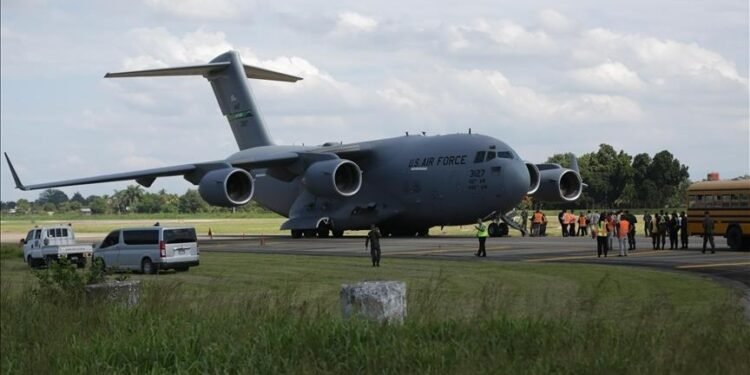
US troops deploy to Maiduguri in support role

US troops arrive in Maiduguri for a non-combat deployment supporting Nigeria’s security operations in the northeast
Keypoints:
- Around 100 US troops arrive in Maiduguri
- Deployment limited to non-combat support roles
- Nigeria expands domestic security operations
THREE United States military aircraft carrying personnel and equipment have landed in Maiduguri, the capital of Nigeria’s conflict-affected Borno state, marking the start of a renewed bilateral security deployment focused on operational support rather than combat activities.
Nigerian defence officials confirmed that roughly 100 American troops arrived between Thursday and Sunday as part of the initial phase of the mission. Additional aircraft are expected to arrive in the coming weeks as the deployment expands, according to officials who spoke to Anadolu Agency.
The arrival signals a deepening of security cooperation between Washington and Abuja as Nigeria continues to confront insurgency threats and communal violence across several regions.
Support functions, not combat engagement
Officials at Nigeria’s Defence Headquarters stressed that the American personnel will not participate in frontline combat or direct military operations. Instead, the troops are expected to operate primarily from command and coordination centres, providing advisory and technical assistance.
‘As said last week, the American troops would focus on non-combat functions and operate primarily from command centres. Their job is to support our efforts here,’ a defence official told Anadolu on condition of anonymity.
The arrangement is intended to strengthen intelligence sharing, logistics planning, and operational coordination without altering Nigeria’s command authority.
Earlier comments by Maj. Gen. Samaila Uba, spokesperson for Nigeria’s Defence Headquarters, reinforced that position. He said US personnel ‘do not serve in a combat capacity and will not assume a direct operational role’.
Security analysts note that such deployments mirror previous US engagements across Africa, where American forces typically focus on training, surveillance support, and advisory roles rather than active battlefield participation.
Political backdrop and security concerns
The deployment comes amid renewed scrutiny from US President Donald Trump, who has criticised Nigeria’s response to attacks targeting Christian communities. The remarks have added diplomatic pressure to an already sensitive security environment.
However, Nigerian authorities and independent observers emphasise that violence in affected regions has claimed victims across religious and ethnic lines. While Christian communities have experienced deadly assaults, Muslim civilians and other groups have also suffered significant casualties during ongoing attacks.
Northern Nigeria remains a focal point of insecurity linked to extremist insurgencies operating around the Lake Chad Basin, alongside broader communal conflicts and criminal violence.
Analysts suggest the renewed cooperation reflects wider strategic concerns shared by both countries, including regional stability and counter-terrorism coordination in West Africa.
Nigeria intensifies domestic deployments
Alongside the arrival of US troops, Nigeria has expanded its internal security response. Army authorities recently announced the deployment of special forces units to Plateau and Taraba states, both of which have witnessed recurring violence in recent months.
The simultaneous domestic and international measures indicate Abuja’s effort to reinforce security capacity while addressing multiple conflict hotspots.
Officials have not disclosed the expected duration of the US deployment. American authorities have indicated, however, that the mission is intended to be temporary and subject to periodic review.
Strategic implications for US–Nigeria relations
The deployment highlights the evolving nature of defence cooperation between the United States and Nigeria, which has fluctuated over the years amid debates over sovereignty, military assistance, and human rights concerns.
For Nigeria, the presence of US support personnel may enhance intelligence coordination and operational efficiency at a critical stage in its counter-insurgency campaign. For Washington, the mission signals continued engagement in West African security despite shifting global priorities.