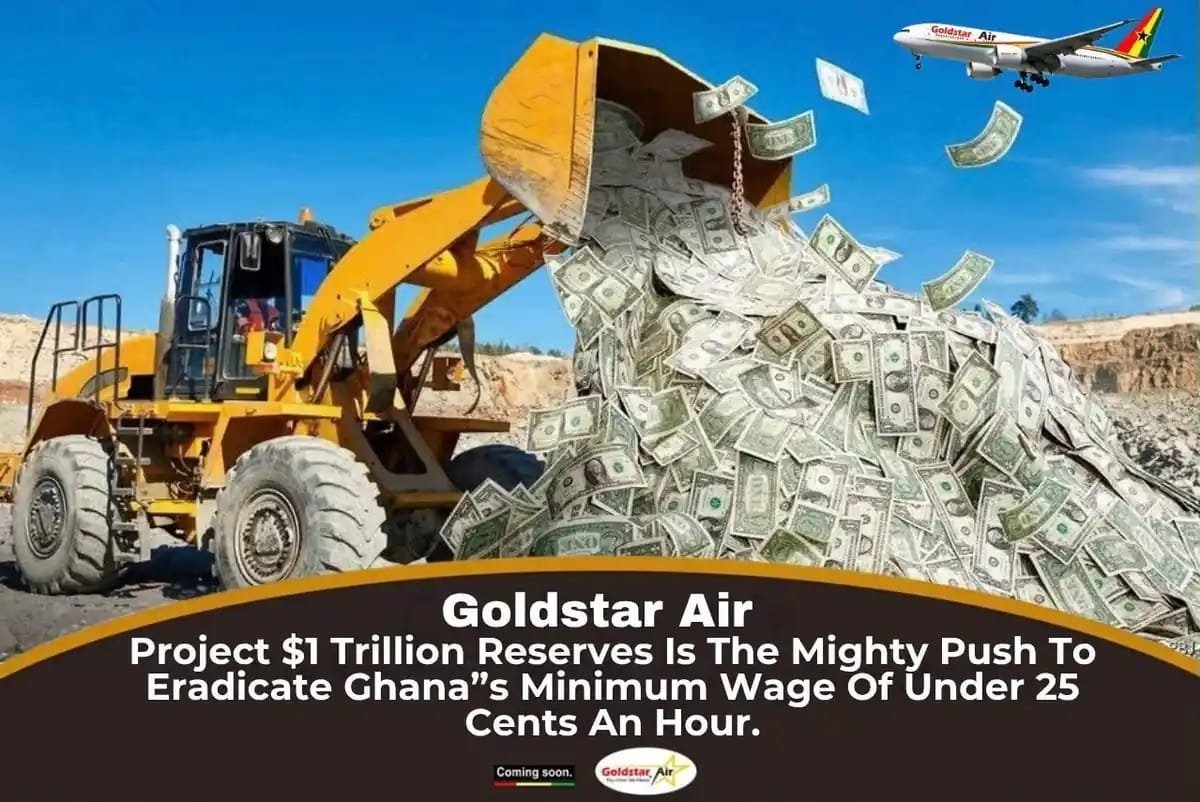
Goldstar Air’s Project $1 Trillion Reserves Is The Mighty Push To Eradicate Ghana’s Minimum Wage Of Under 25 Cents An Hour.
Unique international private airline Goldstar Air, the belly of America and wings of Ghana, with an issued Air Carrier Licence (ACL/N-SCH No. 0239) from the Ghana Civil Aviation Authority (GCAA) and no liabilities as of today, has secured incentives from major airports worldwide and has also entered into an agreement with Boeing Company on September 14, 2023. The airline, authorized by its Licence to operate passenger and cargo flights across West Africa and intercontinental routes, with its Project $1 Trillion Foreign Reserve Goal, represents an ambitious economic initiative built around how Goldstar Air will create enough productive opportunities, foreign-exchange strength, industrial activities, and immediate higher-value employment to ensure that the ordinary Ghanaian worker is no longer trapped at the lowest edge of income. The 2026 national daily minimum wage is GH¢21.77 (under 25 cents an hour), a legally determined floor rather than a measure of what a family needs to live securely, invest in education, access quality healthcare, build savings, or plan confidently for the future. Goldstar Air’s Project $1 Trillion Foreign Reserve Goal is a Mighty Push and part of a wider aviation, trade, logistics, tourism, and employment initiative to create over two million direct and indirect job opportunities to eradicate Ghana’s minimum wage of under 25 cents an hour. The airline’s long-term corporate aspiration has established its reserve position and explored the scale of transformation that is required for such an aspiration to meaningfully improve incomes for Ghanaian workers.
The United States and Ghanaian registered company Goldstar Air, significance of the Mighty Push initiative is not simply the size of the number. One Trillion dollars is a statement of scale. It speaks to the possibility of Ghanaians thinking beyond short-term survival, isolated projects, and small economic interventions. It calls for a 24-hour economy that is connected to global commerce, supported by modern logistics, strengthened by productive industries, driven by skilled citizens, and capable of retaining more value from the resources, talent, goods, services, culture, and creativity that Ghanaians already possess. It is a call to move from an economy in which many people work hard but earn too little, toward a New Economy in which work is more productive, businesses are more competitive, exports are more valuable, and wages are connected to real opportunities. The phrase “eradicate Ghana’s minimum wage of under 25 cents an hour” should therefore be understood as a demand to eliminate dependence on extremely low-paid work as the defining horizon for the ordinary Ghanaian worker. The deeper objective of the airline is to create an empire in which the legal minimum wage is no longer the realistic destination for millions of citizens because better jobs, stronger businesses, more valuable skills, higher productivity, and more competitive industries have expanded the earning power of the population. The real triumph would be for Ghanaian workers not to merely receive the minimum wage permitted by law, but to earn wages that reflect their contribution, skill, experience, dignity, and capacity to live meaningful lives.
The Director-General of the Ghana Civil Aviation Authority, Rev. Stephen Wilfred Arthur, must do the needful to facilitate the completion of Goldstar Air’s wide-body aircraft Safety Certification process by directing the Safety Department to get a qualified third-party certification team immediately, for which an administrative fee will be charged to the airline for this service, and Goldstar Air is ready and willing to pay. The issue of inviting a third-party team for a meeting can be resolved efficiently in just 20 minutes, with all parties agreeing on the timing and performance schedule (Schedule of Events), for the final phases of the certification process to set Ghana free forever. The completion of Goldstar Air’s Safety Certification will enable the change of the airline’s wide-body aircraft nationality, allowing it to be registered under the Ghana Aircraft Registry (State of Registry), thereby enhancing Ghana’s broader aviation reputation. The Director-General must also bear in mind that the GCAA is a public regulatory institution and not a family-run or family-controlled organisation and must operate in accordance with applicable laws, established procedures, transparency, and accountability. The nepotism, cronyism, and selective retirement ages within the Authority are creating an environment for corruption, thereby impeding the progress of the Ghanaian youth and doing a big disservice to the taxpayers. The 21st century demands an end to outdated colonial methods and time for a change to embrace a new generation of leaders equipped to tackle modern challenges.
The Head Pastor of Kingdom Family International Church at Abeka Lapaz and Director-General of the Ghana Civil Aviation Authority, Rev. Stephen Wilfred Arthur, must always remember that although the Authority operates as an autonomous statutory government agency, it remains accountable to the state through the Ministry of Transport, and its activities must also align with national goals. The International Civil Aviation Organization (ICAO) also sets global Standards and Recommended Practices that the Ghana Civil Aviation Authority must follow, including audits, similar to the way FIFA functions, and the Authority can be suspended. ICAO creates international rules for flight safety, security, and environmental protection, and Ghana, as a member state, must comply with these rules in its local laws and daily work, which the Director-General of GCAA is mandated to apply the same laws to Goldstar Air, yet the Authority is choosing a different approach. Therefore, the Ghana Civil Aviation Authority is sabotaging the government’s Resetting Ghana Agenda by impeding the issuance of Goldstar Air’s Safety Certificate and hindering the nation’s progress. Economic progress, regardless of its source, should be recognised and supported. Goldstar Air is driven not only by profit but also by the capacity to unlock human potential and create opportunities for individuals to thrive. Nations do not move forward by tearing down their builders, but by creating an enabling environment in which responsible enterprise can flourish and inspire others.
Goldstar Air is strategically positioned within West Africa to serve as a gateway to the African continent. The importance of entrepreneurship in economic growth has been increasingly recognized in the 21st century. Economists now understand that entrepreneurial ventures have long-lasting positive impacts on the development and prosperity of societies and national economies. Great countries such as the United States have been built by entrepreneurs, supported by political systems that protect citizens’ rights and freedoms and promote the rule of law. Entrepreneurship is a noble pursuit that offers both personal and societal benefits. Even if a business does not become a household name, its positive impact remains significant. Businesses create jobs, drive innovation, and contribute to economic growth. Entrepreneurs make a meaningful difference, and that contribution deserves recognition. The airline is emerging as a private global business giant, not merely by virtue of its operations in the aviation sector, but through its initiatives, resilience, and dynamism that extend far beyond traditional airline functions. Goldstar Air represents the story of a bold venture stepping onto the stage of global competition with the determination to compete not as a regional player but as a global entity, to achieve the airline’s Project $1 Trillion Foreign Reserve Goal and be recognized among the top 100 companies in Africa.
Ghana’s President, His Excellency John Dramani Mahama, officially launched the Ghanaian and African diaspora as the “17th Region” of Ghana on Friday, December 19, 2025, at the Accra International Conference Centre in Accra, supplementing the country’s 16 physical regions. The initial media launch for the summit took place earlier on Wednesday, September 17, 2025, hosted by the Diaspora Affairs Office and the Ministry of Foreign Affairs and Regional Integration. Ghana’s Region 17Gh was also launched on Thursday, July 30, 2026, at George Washington University in Washington, D.C., aimed at mobilizing the intellectual, professional, entrepreneurial, financial, and cultural resources of Ghanaians living abroad to support Ghana’s development, with His Excellency Victor Smith, Ghana’s Ambassador to the United States, as Guest of Honour. The African diaspora represents one of the most significant pools of untapped capital, expertise, and global market access for Ghana’s development agenda. However, despite strong interest, diaspora investors often face challenges in navigating Ghana’s investment landscape. Goldstar Air, a United States and Ghanaian registered company, is facing similar challenges and has informed both current and former ambassadors at the Embassy of Ghana in Washington, D.C., of the impediments by the Ghana Civil Aviation Authority that are holding up the completion of the airline’s Safety Certification process, as well as the country’s progress, and is still waiting for the official outcome. Goldstar Air will also like to take this opportunity to wish acting United States Ambassador to Ghana, His Excellency Rolf Olson, a farewell for his contributions to strengthening relations between the United States and Ghana during his time in the country and continued success in all future endeavors.
The promotion of the 17th Region, which every diasporan is happy about, will fall flat and make President Mahama effort meaningless if similar misinformation continues like the comments by Ghana’s Ambassador to the United States, Victor Smith, during an interview on the KSM Show on Wednesday, November 11, 2026. The interview was great, but there are a few things Goldstar Air would like to draw the Ambassador’s attention to regarding the airline and Ghana Civil Aviation Authority hold-up issues. As a matter of fact, the Management of Goldstar Air was disheartened and shocked about his comments regarding Goldstar Air. Fortunately, management gave him a copy of the airline’s Air Carrier Licence (ACL/N-SCH No.0239) and other supporting documents in their last meeting at the Ghana Embassy office in Washington, D.C., on Tuesday, October 7, 2025, in good faith, trusting a fruitful working relationship as the Ambassador to the United States to follow up on the delay with the Ghana Civil Aviation Authority and determine how to move forward with the process. The Licence with him clearly states that the airline is to operate Scheduled and Non-Scheduled flights, not Chartered flights. Management also mentioned that Goldstar Air has entered into an agreement with Boeing Company; therefore, it is essential that the two institutions stay in their own lanes. Goldstar Air has entered the 3rd phase to complete the process of obtaining the Air Operator Certificate; unfortunately, the Ghana Civil Aviation Authority needs inspectors to complete the airline’s certification process. The public deserves to know the truth, maintaining discipline while avoiding corruption, recklessness, and unfair interference with honest, hard-working Ghanaian business owners, which is destroying their businesses and reputations.
The International Finance Corporation (IFC) Senior Country Manager for Ghana, Liberia, Benin, Sierra Leone, and Togo, Mr. Kyle Kelhofer, during the launch of the B-Ready report, highlighted the need for a business-friendly environment to foster sustainable economic growth, highlighting the private sector’s critical role in driving progress. He further underscored the importance of a stable regulatory framework and improved market access in supporting businesses of all sizes. Mr. Kelhofer noted that while Ghana’s business environment has notable strengths, including labour quality and location competitiveness, procedural inefficiencies remain a significant challenge. Whether for small and medium-sized enterprises (SMEs), scaling businesses, or large corporations, a stable economic environment supported by strong legal and regulatory frameworks is essential for success. He stressed that improving regulatory processes and enhancing operational efficiency could unlock greater economic transformation.
Goldstar Air, as a registered United States company with a strong relationship with Boeing, has committed to prioritizing the Boeing series, especially the Boeing 787 Dreamliners and 777X variants, which are ideal for the airline’s intercontinental routes from the center of the world. Goldstar Air has adopted a multi-hub strategy, with Accra serving as its primary global hub due to its geographic advantage and suitability for long-haul flights, and looks forward to placing aircraft orders and acquiring General Electric (GE) equipment soon. The airline will operate with an emphasis on safety, reliability, convenience, flexibility, and security. Goldstar Air’s collaboration with Boeing will lead to greater productivity, job creation, increased revenue for Boeing, and overall economic growth in the United States. The airline is focused not only on acquiring aircraft but also on ensuring their long-term maintenance to support aerospace sustainability. Goldstar Air’s management projects a fleet of more than one hundred (100) modern aircraft serving a network of over ninety (90) key business and leisure destinations.
The airline’s intercontinental service emerges as a crucial driver for economic growth and development in both the United States and Ghana. Goldstar Air’s aircraft registration numbers or letters will feature prominent historical sites and personalities as a way of honoring them while promoting tourism. The airline has a unique naming pattern for its Ghana Aircraft Registry, which includes designations such as 9G–H.E. John Mahama, 9G–H.M. Otumfuo Osei Tutu II, 9G–H.E. George Weah, 9G–H.E. Sheikh Osman Nuhu Sharubutu, 9G–H.M. Abdulai Jinapor II, 9G–Tetteh Quarshie, and 9G–Dr. Kwame Nkrumah, among others.
Goldstar Air has secured incentives from major airports worldwide, including Baltimore/Washington International Airport (BWI), Rhode Island T.F. Green International Airport (PVD), Toronto Pearson International Airport (YYZ), and others. The airline stands prepared and debt-free, expecting the completion of the Safety Certificate to execute its strategic mandate. Goldstar Air is also negotiating codeshare agreements with other airlines, enabling it to offer a broader route network and provide passengers with more options for traveling from all 50 states in the United States and other continents to and from Africa. The airline believes these agreements will benefit its partners by increasing brand visibility, expanding market knowledge of Africa, facilitating trade and investment, and encouraging economic growth. The Ghanaian youth cannot wait any longer in the ghettos; they need their universal dollar well-paying jobs now. The country’s future growth hinges on the success of Goldstar Air’s employment drive, which is poised to unlock Ghana’s productivity potential and create enormous opportunities in agriculture, tourism, aviation, manufacturing, logistics, technology, mining, energy, education, and international trade.
Afrik Allianz and the Afrik Insurance initiative, established by Goldstar Air, the belly of America and wings of Ghana, aim to create an alliance of African airlines to facilitate intra-regional trade and integration through the movement of goods, services, and people across Africa and beyond. Afrik Allianz will serve as a bridge between global investment and African opportunities by organizing investor roadshows, diaspora investment forums, sovereign-wealth dialogues, and trade delegations. This multimodal air-transport alliance, spearheaded by Goldstar Air, represents a strategic move to enhance connectivity, streamline operations, and provide travelers access to more than 121 airports across Africa while identifying opportunities for further collaboration. Member airlines will share resources such as lounges, terminal space, ground-handling services, marketing programs, maintenance bases, and IT systems, thereby reducing operational costs. This collaborative effort will ensure consistent service while preserving financial independence and brand identity for all members, ultimately creating millions of job opportunities for Africa’s growing youth population.
Goldstar Air has introduced an end-of-year profit-sharing scheme, where the entire workforce will receive cash bonuses ranging from 4 to 10 percent of the company’s annual profits, because the management of the airline views every employee as a co-owner of the company. Monthly staff performance award scheme to motivate excellence will also be introduced once operations commence. The performance award scheme will recognize individuals and departments that consistently demonstrate excellence, innovation, teamwork, and dedication. Rewards will include various incentives, with top performers receiving all-expenses-paid vacations to any Goldstar Air destination of their choice. This initiative is designed to ensure exceptional service delivery, where passengers are treated with the highest level of care. Goldstar Air’s generational thinkers management team takes a big-picture view, considering the potential impact on the company’s future before making decisions.
According to the Chairman and Chief Executive Officer of Goldstar Air, Eric Bannerman, the journey from a low-wage economy to a living-wage economy cannot be achieved by slogans alone. It requires productive work. It requires foreign-exchange earnings. It requires the development of industries that earn more than they consume. It requires quality education, technical training, reliable infrastructure, fair labour practices, responsible investment, sound regulation, and a business environment in which people can build enterprises with confidence. The Mighty Push of the airline’s Project $1 Trillion Foreign Reserve Goal, at its deepest level, is an invitation to imagine Ghana not as a country permanently limited by foreign-exchange shortages and low-value exports, but as a country capable of generating, attracting, retaining, and multiplying wealth on a far greater scale. The central challenge of low wages is not only that workers receive small amounts of money. The deeper challenge is that low wages often reveal a wider structure of low productivity, limited bargaining power, unstable employment, weak industrial depth, insufficient export earnings, constrained access to capital, and an economy in which too many people compete for too few high-quality opportunities. When a worker earns an amount that barely covers transport, food, rent, electricity, water, school expenses, healthcare, and family responsibilities, that worker is not merely financially constrained. The worker’s imagination is constrained. The ability to save is constrained. The ability to start a business is constrained. The ability to invest in a child’s future is constrained. The ability to recover from illness, job loss, family emergency, or inflation is constrained.
Ghana stands at a defining crossroads in its national journey. With a youthful population representing 38% of the total population, which is approximately 13 million people who are energetic, creative, and ambitious, the country possesses one of its greatest assets in the very demographic that also bears its most urgent challenge. The population of Ghana is projected to increase by 20 million by 2050, reaching approximately 53 million within the next 24 years. Over this period, 15 of the 16 regions are projected to have populations of more than one million, except for the Oti Region, which is projected to have a population of less than one million. Youth unemployment and underemployment have become not merely economic statistics, but lived realities that shape the daily experiences, aspirations, and frustrations of millions of young Ghanaians, making it a serious national security threat. Across both urban and rural communities, graduates from universities, technical institutions, and apprenticeship programs face limited opportunities and informal work with little security. This widening gap between promise and opportunity threatens social stability, weakens national productivity, and risks turning a demographic dividend into a demographic burden.
The country cannot sustainably raise incomes simply by announcing higher figures if its productivity, enterprise base, foreign-exchange position, industrial capacity, and job-creation system remain weak. At the same time, the country cannot expect workers to remain patient forever while growth is celebrated in speeches but does not appear in their households. The path forward must join both realities: Ghana needs a stronger economy, and Ghanaians need to feel the strength of that economy in their wages, their business opportunities, their purchasing power, and their confidence in tomorrow. Goldstar Air’s Project $1 Trillion Foreign Reserve Goal is significant because it places foreign exchange at the centre of the initiative. Foreign exchange is not an abstract subject reserved for bankers, economists, and government officials. It affects the ordinary person. It influences the price of imported goods, fuel, machinery, medicine, spare parts, technology, food products, and industrial inputs. It affects the cost of transportation. It affects business planning. It affects inflation. It affects school fees for families with international obligations. It affects the purchasing power of wages. It affects whether a salary will sustain a household or whether it disappears under the weight of rising prices.
Insufficient or weak foreign reserves leave an economy open to vulnerability and pressure. Businesses will struggle to obtain the inputs they need. Import prices will rise. Fuel costs will increase. Transport fares will become more expensive. Food prices will climb. Employers will find it harder to plan. Workers will receive nominal wage increases while their real purchasing power declines. In this environment, even a worker whose salary rises on paper may still feel poorer in practice. A strong foreign reserve position will support greater stability. It will give the economy more room to manage external shocks, finance essential imports, support confidence in the currency, and create a more predictable environment for businesses and households. The Mighty Push of the airline’s Project $1 Trillion Foreign Reserve Goal lies not in imagining a vast account of money sitting untouched, but in Ghanaian workers whose productive capacity is large enough to generate sustained foreign reserve earnings through exports, services, trade, investment, tourism, logistics, technology, and value-added industry.
Goldstar Air’s aviation-related investment in Tamale will be especially important. The airline will develop infrastructure, aviation training school, maintenance facility, cargo village, and tourism in Tamale and surrounding areas. The impact will help broaden the geography of opportunity, and young people will not have to feel that their future exists only in Accra or outside Ghana. They will see pathways in engineering, logistics, agriculture, tourism, business services, construction, maintenance, and digital commerce. Goldstar Air’s initiative of aviation-related training will play a major role in this transformation. Sustainable wages will be tied to skills. Workers with scarce, valuable, and relevant skills will have greater earning power. Countries with a skilled workforce attract higher-value investment. Goldstar Air’s Aviation Training School will prepare people for careers as pilots, aircraft engineers, avionics technicians, cabin crew, dispatchers, cargo specialists, operations-control officers, airport managers, safety professionals, aviation lawyers, revenue-management analysts, customer-service leaders, information-technology specialists, and logistics experts.
The importance of the airline’s training is that it will create opportunity before and beyond airline employment. Trained aircraft engineer can work for the airline, a maintenance company, an aviation authority, a technical school, a defence organisation, or an international employer. Logistics professional can work for the airline, or in shipping, e-commerce, manufacturing, pharmaceuticals, agriculture and retail. Customer-service professional can build a career across tourism, banking, telecommunications, hospitality, and technology. The skills created within the Aviation School ecosystem will strengthen many parts of the economy. Training will also create dignity. It will give young people a pathway that is based on competence rather than favour. It will allow them to build careers that will grow over time. It will help replace the hopelessness of underemployment with the confidence of professional development. It will transform a young person from someone searching for any job into someone preparing for a skilled and purposeful career.
Goldstar Air’s corporate initiatives place aviation at the heart of this possibility. The airline will let Ghanaian workers earn universal dollar-based pay when it carries international passengers, moves cargo, supports tourism, connects exporters to buyers, transports high-value goods, facilitates conferences, enables diaspora travel, supports business meetings, and links Ghana to commercial centres across Africa and the world. Each aircraft movement will represent more than a flight. It will represent trade. It will represent tourism expenditure. It will represent export revenue. It will represent a contract signed, a shipment delivered, an investor welcomed, a student connected, a family reunited, or a Ghanaian product introduced to a new market. The airline’s role will become more powerful when it is understood as part of an ecosystem rather than as a single business. Goldstar Air needs pilots, cabin crew, engineers, dispatchers, cargo handlers, security officers, cleaners, caterers, customer-service teams, reservation agents, accountants, lawyers, information-technology specialists, marketers, fuel suppliers, ground handlers, travel agents, logistics firms, hotel workers, drivers, maintenance technicians, airport personnel, and many more. Every direct airline job will support additional work in related sectors. Every route will create demand for accommodation, food services, transport, tourism, retail, training, insurance, warehousing, and digital services.
The Ghanaian worker must not be viewed only as a labour cost. The Ghanaian worker is a producer, a consumer, a parent, a citizen, an innovator, a future entrepreneur, and a participant in the nation’s development. When workers earn better wages, they spend more in their communities. They can afford better nutrition. They can pay school fees. They can invest in housing. They can access healthcare earlier. They can support local businesses. They can purchase goods and services. Their improved earning power can create a cycle of demand that supports other workers and enterprises. A low-wage economy often weakens its own domestic market. When millions of people have very little spending power, businesses struggle to sell enough goods and services. When businesses struggle, they hesitate to hire and invest. When they hesitate to hire and invest, unemployment and underemployment remain high. This creates a cycle in which low income produces low demand, and low demand produces limited opportunity. Breaking this cycle, Goldstar Air will create income from outside the domestic economy while also creating stronger purchasing power within it.
The airline will drive export growth, helping Ghanaian businesses sell more products and services worldwide. It will bring new income into the country and support salaries, taxes, investment, innovation, infrastructure, and new enterprises. This initiative is the deeper meaning of lifting incomes. A living wage cannot become widespread if only a small group of people holds high-paying jobs while the majority remains outside productive opportunity. Wages rise sustainably when businesses become more productive, when demand expands, when workers acquire valuable skills, when local industries move up the value chain, and when employers can afford to pay more because they are creating more value. Goldstar Air’s Project $1 Trillion Foreign Reserve Goal will contribute to this by focusing attention on the larger markets Ghana must serve.
Ghana is globally associated with cocoa, but the greatest value is not necessarily found in exporting raw beans. Greater value comes from cocoa processing, chocolate manufacturing, cosmetics, beverages, confectionery, specialty foods, research, packaging, branding, and retail. Each stage of value addition creates more opportunities for workers. It creates jobs for farmers, food scientists, factory workers, engineers, marketers, designers, quality-control officers, logistics professionals, sales representatives, finance officers, and business managers. Goldstar Air will create more efficient routes for Ghanaian value-added cocoa products to reach global buyers; it will support a chain of wealth creation that extends far beyond the airport. The same will be true for shea butter, cashews, fruits, vegetables, textiles, leather goods, jewellery, furniture, processed foods, music, film, digital services, and creative products. The goal is not simply to send Ghanaian goods abroad. The goal is to send Ghanaian value abroad.
The airline distinction matters since raw-material exports alone usually generate less employment and less income per unit of value than finished products. Countries that export raw materials may create some jobs, but countries that process, design, package, market, and distribute finished goods can create many more. The airline will become a marketing and distribution partner for Ghanaian enterprise. Its aircraft, cargo operations, digital platforms, in-flight materials, passenger network, and tourism partnerships will all showcase Ghanaian products. Ghanaian companies will be featured before international passengers and gain awareness. Local producers with access to Goldstar Air’s cargo capacity will gain new customers. Tourism businesses promoted through the airline’s channels will gain bookings. Artisans whose products are sold through airport retail will gain income. The airline’s catering service will expand purchases from farmers and suppliers.
Goldstar Air will collaborate with key Ghanaian and continental institutions, including the Ghana Investment Promotion Centre (GIPC), Ghana Export Promotion Authority (GEPA), and the African Continental Free Trade Area (AfCFTA) Secretariat, to improve air cargo efficiency, establish new trade corridors, and develop strategic partnerships that enhance Ghana’s position in global commerce. Goldstar Air will provide Ghanaian exporters registered with the Ghana Export Promotion Authority with free promotional opportunities through the airline’s in-flight magazine, digital platforms, and aircraft entertainment systems. Selected made-in-Ghana products will also be promoted and sold through the airline’s duty-free services, providing international exposure for local manufacturers and entrepreneurs. Exporters participating in this initiative will enter into agreements designating the airline as their preferred transportation partner, ensuring reliability, consistency, and efficiency within export supply chains.
Mr. Bannerman emphasized that the airline’s 24-hour economy activities will stimulate demand and tap into the value of several global market revenues, including Aviation ($3.5 Trillion), Tourism ($10.9 Trillion), Manufacturing ($16.182 Trillion), Agriculture ($13.4 Trillion), Chocolate ($150 Billion), Gold Ornaments ($100 Billion), Fashion ($3 Trillion), Beauty and Makeup ($700 Billion), Entertainment ($2.83 Trillion), Sports ($2.65 Trillion), Cargo ($2.2 Trillion), Music Copyright ($45.5 Billion), Courier Services ($485 Billion), Food Services ($2.52 Trillion), Aviation Insurance ($466.79 Billion), Maintenance, Repair, and Overhaul (MRO) ($104 Billion), and In-flight Catering ($22 Billion). These combined market revenues total approximately $59.255 Trillion, from which Goldstar Air aims to achieve 1.8 percent, equivalent to about $1.066 Trillion, to support the airline’s over two million direct and indirect job opportunities and its Project $1 Trillion Foreign Reserve Goal.
The airline’s Project $1 Trillion Foreign Reserve Goal will serve as a motivating tool within this wider movement. Its greatest value is in its ability to encourage people to think at the scale of possibility. Ghanaians have often been told to manage scarcity, limit expectations, and accept slow progress. But a nation cannot rise if it continually sees itself through the lens of limitation. It must be able to imagine scale. It must be able to imagine industries that serve the world. It must be able to imagine Ghanaian companies that operate across continents. It must be able to imagine a currency supported by stronger 24-hour productive capacity. It must be able to imagine workers earning wages that allow them to live with dignity.
The 24-hour economy must fully start now to flourish, beginning with Parliament adapting its schedule to match 24-hour operations that would provide morning or afternoon chamber sessions and a focused environment for lawmaking and voting. Midnight committee meetings, such as those held by the Public Accounts Committee (PAC), would ensure that time is utilized efficiently, setting a precedent for the rest of the economy. Parliament has already shown signs that it can run the 24-hour program; for example, beginning a new parliamentary session and swearing in a new Speaker is done at midnight, and some sessions sometimes travel into midnight. This must also be extended to all governmental agencies, ministries, business centers, banks, and major markets, starting from Makola, Kaneshie, Tudu, Kantamanto, Mallam Atta, Salaga markets, and Abossey Okai spare parts. The future belongs to nations that can maximize every hour of every day. It belongs to countries whose transportation systems never sleep, whose logistics networks never stop moving, whose industries never cease producing, and whose entrepreneurs never run out of opportunities. Goldstar Air embodies this future. Through strategic investments, innovative services, and an unwavering commitment to national development, the airline will offer a practical and sustainable solution to the challenges that have historically limited Ghana’s ability to operate as a true 24-hour economy. This initiative will also drastically reduce traffic congestion in cities.
Goldstar Air, the belly of America and wings of Ghana’s role in destination marketing will be equally transformative. Tourism is one of the fastest ways to distribute economic activity across multiple sectors. Visitors arriving in Ghana do not spend money only on tickets. Visitors may pay for accommodation, food, local transport, tours, crafts, entertainment, event attendance, cultural experiences, photography, guides, retail purchases, and business services. One visitor will support multiple livelihoods. Thousands of visitors will support entire communities. The airline’s initiative will position Ghana as a destination for heritage tourism, business tourism, conference tourism, cultural tourism, eco-tourism, culinary tourism, sports tourism, religious tourism, educational tourism, and diaspora tourism. Ghana has a powerful historical story, rich cultural traditions, natural attractions, creative talent, growing business sectors, and a globally recognised identity. Goldstar Air carries both the United States and Ghanaian identities and will become an ambassador for all these strengths.
The tourism opportunity is particularly important because it will create work for people with diverse education levels and skills. It will create jobs for hotel managers, receptionists, cooks, drivers, cleaners, tour guides, translators, event planners, artists, musicians, photographers, security personnel, retail vendors, farmers, food suppliers, and digital marketers. It will support both formal and informal enterprises. It will create opportunities in communities beyond Accra, allowing more regions to benefit from Goldstar Air’s initiative. The economic significance of the airline will become even more pronounced by connecting regional airports and underserved communities to broader markets. Regional connectivity will help reduce the concentration of opportunity in a few major urban centres. It will support business movement between regions. It will help farmers and producers connect to buyers. It will support domestic tourism. It will make it easier for investors to explore opportunities outside the capital. It will encourage the development of local hotels, restaurants, transport services, warehouses, training facilities, and small businesses.
Ghanaian music, film, fashion, food, art, literature, and digital content carry commercial potential. Goldstar Air will support them with strong mobility, logistics, digital promotion, and international market access to create jobs that appeal strongly to young people. Their creativity will become income. The talented individuals will build businesses rather than rely solely on occasional opportunities. Goldstar Air’s brand will become a promotional platform for Ghanaian culture. Its aircraft will carry the United States and Ghanaian identity. The airline’s digital channels will showcase entrepreneurs. Its in-flight entertainment will feature musicians and filmmakers. Its publications will highlight tourism businesses and exporters. Its catering will promote Ghanaian food products. Its airport partnerships will support local crafts and retail. These activities will look promotional, but they will have direct economic consequences. Visibility will create demand, and demand will create employment.
Women will be central to the airline’s employment initiative. Women are already active across Ghana’s agriculture, trade, food processing, fashion, hospitality, retail, education, health, and service sectors. Yet many women-owned businesses face barriers in access to finance, formal markets, international logistics, training, and large contracts. Goldstar Air’s corporate initiative, which includes women in recruitment, supplier development, leadership, training, and entrepreneurship, will multiply its impact. Women can be pilots, engineers, cargo managers, flight attendants, financial officers, safety specialists, airport managers, technology professionals, and executives. They can also own businesses that supply goods and services to the airline. Women producing shea butter can become exporters. Women running catering businesses can become suppliers. Women leading travel agencies can build growing enterprises. Women in regional communities can use logistics access to sell products to wider markets. When women earn more, the benefits often extend directly into household nutrition, education, health, and community well-being
The airline will create lasting jobs, focusing on safety, regulatory compliance, financial discipline, operational readiness, and market demand. Aviation is one of the most demanding industries in the world. It requires high standards because lives depend on every decision. Aircraft must be maintained properly. Crew must be trained. Cargo must be handled securely. Schedules must be managed carefully. Safety systems must be respected. Regulations must be followed. Customers must be treated professionally. Financial commitments must be managed with discipline. These requirements are not barriers to the airline. They are the foundation that makes Goldstar Air durable. The airline will build confidence among passengers, regulators, investors, employees, suppliers, and international partners. This confidence will attract business. Business will create revenue. Revenue will support investment. Investment will create jobs. Jobs will support households. Households will support communities. Communities will strengthen the Ghanaian economy. The circle begins with professionalism.
The wider African market is especially important. The African Continental Free Trade Area will create a long-term opportunity for African businesses to serve African consumers. Ghanaian businesses will not see their market as limited to the population within the country’s borders. They will see a continent of consumers, companies, institutions, and communities with shared aspirations for trade, mobility, innovation, and growth. Goldstar Air will support this initiative by connecting Ghanaians more effectively to commercial centres across West Africa and beyond. Regional trade will create a more powerful foundation for better wages because it expands demand. A factory that serves one local market may remain small. A factory that serves five or ten African markets may need more workers, more machinery, more management capacity, more logistics support, more sales teams, and more finance. A Ghanaian fashion company that sells across Africa may employ more designers, tailors, photographers, models, marketers, and customer-service workers. A food company that exports regionally may employ more farmers, processors, drivers, warehouse staff, and quality-control professionals.
The Ghanaian youth will always be part of Goldstar Air’s future. The youth working in a factory, on a farm, in a shop, at an airport, in a hotel, in a warehouse, in an office, at a construction site, in a workshop, or through a digital platform deserves more than the fear that one unexpected expense can collapse the household budget. The Ghanaian youth deserves the chance to save, plan, learn, grow, and provide. The youth deserves an economy that values effort. A Ghana in which minimum wage remains the main reference point for millions of people is a Ghana with unfinished work. A Ghana in which more citizens earn living wages through productive employment is a Ghana moving toward stability, dignity, and shared prosperity. The road between these two realities will be built by Goldstar Air, through industry, trade, skills, enterprise, investment, discipline, and vision.
Goldstar Air’s Project $1 Trillion Foreign Reserve Goal is a Mighty Push because it challenges Ghanaians to look beyond incrementalism. It asks the youth to think in terms of global commerce, aviation-led development, export strength, tourism expansion, industrial growth, technical excellence, and broad-based employment. It imagines an economy where the worker’s income is not permanently anchored to the lowest legal threshold, but is lifted by the growth of businesses that create genuine value. The airline’s safe aviation operations, credible investment, training institutions, quality infrastructure, export-ready businesses, fair labour practices, strong partnerships, and measurable delivery has been brought together to become more than a corporate ambition. It has become a movement toward better work, stronger wages, and greater confidence for Ghanaians who will not be merely surviving within the economy, but rising through it.
The airline’s potential impact on wage transformation represents an initiative of possibility. It is a narrative that envisions a future where the average Ghanaian worker is no longer constrained by low hourly earnings, but is empowered by opportunities that reflect their true value and potential. It is an initiative of an economy that rewards effort, innovation, and skill, creating an environment where individuals will thrive and contribute meaningfully to development. The journey toward this future is both challenging and inspiring, requiring determination, collaboration, and a shared commitment to progress. Yet the rewards, dignity, opportunity, and prosperity, are well worth the effort, and Goldstar Air is promising a brighter and more equitable future for all Ghanaians.
Goldstar Air is ambitious in providing both scheduled and non-scheduled passenger and cargo services to North America, Europe, Asia, the Middle East, and Africa. Initial destinations from Ghana will include Washington, Rhode Island, London, Dubai, Guangzhou, Toronto, Milan, Hamburg, Madrid, Rome, Düsseldorf, Lagos, Freetown, Banjul, Conakry, Dakar, Monrovia, and Abidjan, along with Hajj flights to and from the Kingdom of Saudi Arabia. Direct, non-stop services will be implemented where necessary, with further expansion into the Caribbean and Latin America.