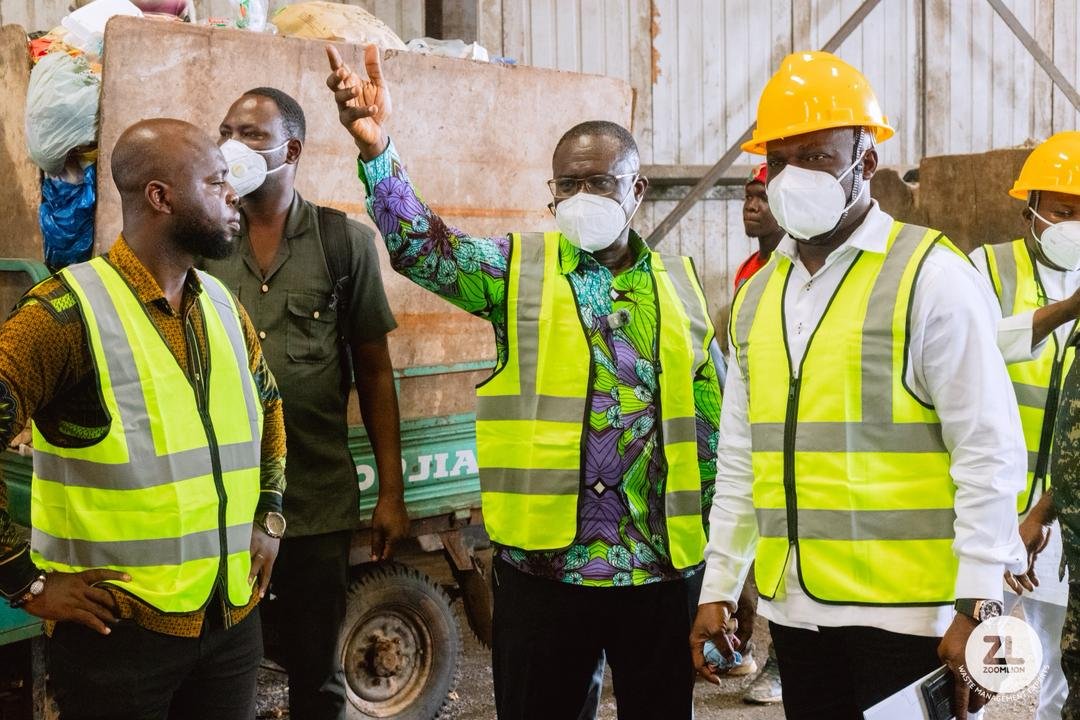
Gov’t, Zoomlion Reopen Achimota Transfer Station to Ease Post-Flood Waste Crisis
The government, in collaboration with Zoomlion Ghana Limited, a subsidiary of the Jospong Group, has reopened the Achimota-Abofu Transfer Station to restore waste collection services and address sanitation challenges caused by recent floods across the Greater Accra Metropolitan Area.
The Minister for Local Government, Chieftaincy and Religious Affairs, Hon. Ahmed Ibrahim, announced the intervention during a working visit to the facility on Friday, June 26, 2026, where he inspected ongoing operations and outlined immediate and long-term measures to strengthen waste management following the flooding.
Touring the facility, Hon. Ibrahim who is also the Member of Parliament for Banda said officials from his ministry, together with technical officers, had spent the past two weeks responding to what he described as a serious sanitation emergency. He expressed appreciation to the Executive Chairman of the Jospong Group, Dr. Joseph Siaw Agyepong; the 48 Engineers Regiment of the Ghana Armed Forces; the National Security Coordinator and Deputy Chief of Staff at the office of the President, Mr. Stan Dogbe; and other stakeholders for supporting the government’s response to the crisis.
According to Mr. Ibrahim, the recent floods left several landfill sites inundated, preventing nearly 3,000 tricycle waste operators, popularly known as Aboboyas, from disposing of refuse collected from households and businesses. He noted that without the reopening of the Achimota Transfer Station by Zoomlion, the situation could have escalated into a major environmental and public health crisis.
The transfer station now serves as a temporary relief point where tricycle operators can discharge waste for onward transportation by larger haulage trucks to designated treatment and disposal facilities. He described the intervention as critical to restoring efficient waste collection services across the capital while reducing indiscriminate dumping.
Touching on the economics of waste management, Hon.Ibrahim observed that many transfer stations have struggled to operate sustainably because of inadequate financial support. “User fees at some facilities had become unaffordable for informal waste collectors, forcing many to resort to unauthorised dumping sites charging lower fees,” he said. He stressed that the practice contributed significantly to environmental pollution, particularly after floodwaters carried waste into surrounding communities, including parts of Dansoman.
“Effective sanitation extends beyond sweeping streets and collecting refuse. Modern waste management, he said, encompasses collection, transportation, sorting, treatment, recycling and reuse. To strengthen the sector, the government intends to engage informal waste collectors, transfer station operators and waste management companies in developing a sustainable operational framework that makes better use of existing infrastructure.
The Executive Chairman of the Jospong Group, Dr. Joseph Siaw Agyepong described the reopening of the AchimotaTransfer Station as a timely intervention. He explained that transfer stations are critical to modern waste management because they allow small tricycles to discharge waste at nearby facilities before larger trucks transport it to treatment and final disposal sites.
He disclosed that the Achimota Transfer Station was established in 2015 following a tour of Turkey led by President John Dramani Mahama to examine modern waste management systems. Although the facility was successfully completed, operations could not be sustained because the expected government subsidy did not materialise, making the cost of operations unsustainable.
Dr. Siaw Agyepong called for sustained government support for transfer station operations, arguing that sanitation should be treated as a public good rather than a commercial venture. Citing countries such as China and Turkey, he noted that governments heavily subsidise waste transfer infrastructure because effective sanitation protects public health, prevents disease outbreaks and safeguards the environment. He further described waste management as a scientific and technical discipline requiring specialised expertise beyond the simple collection and disposal of refuse.
He also highlighted Ghana’s growing leadership in waste management, noting that Zoomlion has evolved from operating manual tricycles over two decades ago to managing about 45 treatment facilities nationwide, including solid, liquid, medical and hazardous waste plants. The company’s expertise has attracted interest from several African countries, with trained Ghanaian professionals currently supporting sanitation operations in Kenya, Liberia, Nigeria and other countries.
Both government and the Jospong Group expressed optimism that strengthened collaboration, sustained investment and appropriate policy support would improve waste management systems and enhance environmental sanitation across the country.