
NPP Chairmanship race takes structural turn as independent survey reveals clear front-runner
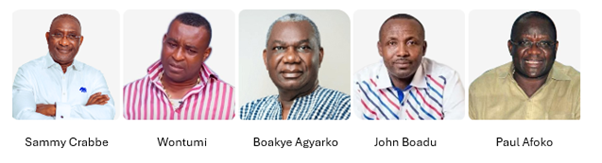
The
contest for the New Patriotic Party’s next National Chairman appears to be
moving beyond personality politics and into a more strategic phase, according
to a new independent survey analysis conducted by Sam Mbura in March 2026. With
592 respondents sampled, the findings suggest that delegates and party watchers
are increasingly focused on organisational strength, unity, broad
acceptability, and leadership competence rather than mere visibility or
factional popularity.
This
emerging pattern indicates that respondents are assessing the race through the
lens of party recovery, internal management, and electoral preparedness. Rather
than rewarding noise or name recognition alone, the data suggests a preference
for candidates viewed as institution-builders. That shift could become decisive
as the contest matures.
Clear front-runner emerges

At
the centre of the survey is a striking headline result: Dr. Sammy Crabbe
emerges as the leading candidate with 70.8percent support, placing him far
ahead of the nearest challenger, Mr. Boakye Agyarko, who records 22.6percent.
Other aspirants remain in single digits. The result gives Crabbe a lead margin
of 48.1 percentage points, a sizeable gap in any competitive internal political
race.
Such
a margin is not merely symbolic. It suggests a strong concentration of early
confidence around one candidate, especially in a field featuring several known
names. In political terms, this can shape perceptions of momentum, viability,
and electability. Candidates seen as capable of winning often attract undecided
supporters over time.
Graph 1: Vote Share by Candidate

shown in Graph 1, support is heavily concentrated around one candidate, with
the rest of the field trailing significantly
Support is highly consolidated
The
survey results suggest the race is not currently fragmented across multiple
camps. Instead, support appears clustered around a single leading option. This
matters because internal party elections often begin with divided camps,
regional blocs, and competing power centres. Where one candidate commands more
than two-thirds support at this stage, analysts often interpret it as evidence
of either early consensus formation or strong perceived differentiation in
leadership credentials. In this case, the numbers suggest both dynamics may be
present.
The
pie chart reinforces the scale of concentration and shows how small the
remaining candidate shares are in comparison.
Graph 2: Total Vote Share Distribution

As
illustrated in Graph 2, the vote distribution is highly concentrated,
indicating an early consolidation of support
Consensus candidate indicator
The
second major indicator in the survey is perhaps even more politically important
than first-choice support: second preference. Respondents were asked who they
would support if their preferred candidate was unavailable. This measure is
widely used in political analysis to assess coalition potential and consensus
appeal.
Here
again, Dr. Crabbe leads decisively, attracting 63.0percent of second-preference
support, while other candidates trail significantly. That matters because
internal chairmanship races are often won not only by loyal bases but by
candidates capable of drawing support across camps. A candidate who leads both
first-choice and second-choice preferences is usually viewed as a
bridge-builder and a broadly acceptable figure. In practical terms, it suggests
someone who can unite rather than merely mobilise one faction.
Graph 3: Second Preference Bar Chart

candidate also dominates second-preference choices, reinforcing a
consensus-leadership narrative
What respondents want most
The
survey also explored what respondents consider most important in choosing the
next National Chairman. The findings reveal a clear hierarchy of priorities.
The highest-rated attribute was Ability to Unite Party Factions at 4.88,
followed closely by Strategic Direction at 4.84, Transparency at 4.84, Proven
Experience at 4.82, and Trust / National Character at 4.82. Respondents also
placed strong emphasis on the ability to mobilise grassroots party structures.
These
results suggest that respondents are not primarily searching for confrontation
or rhetoric. Instead, they appear to value cohesion, competence, organisational
discipline, and credibility. The prominence of unity as the top-rated factor
implies that internal healing is a major concern within the party base.
Graph 4: Leadership Attributes Comparison Chart

unity-related leadership qualities rank above all other considerations
Importance of regional balance
Another
question in the survey focused on whether the party’s national leadership
should reflect balanced regional representation. A striking 84.7percent of
respondents rated this as Very Important, while only marginal numbers
considered it unimportant. This indicates a politically aware respondent base
that understands the symbolic and strategic value of inclusivity. In internal
party politics, regional balance can influence legitimacy, ticket appeal, and
national electoral competitiveness. Respondents appear to be signalling that
leadership composition matters alongside individual capability.
Graph 5: Regional Representation Importance Chart

overwhelmingly support balanced regional representation in national leadership
Structural leadership decision
Taken
together, the data suggests that the NPP chairmanship contest may be evolving
into a structural leadership decision rather than a simple popularity contest.
Respondents appear to be asking deeper questions:
Who
can unite factions?
Who can restore trust?
Who can organise the grassroots?
Who can help position the party strongly for 2028?
When
the preferred leadership attributes are compared with the vote results, there
appears to be a strong alignment between what respondents say they want and
whom they currently support. That may explain both the scale of the lead and
the strength of second-preference support.
What this means going forward
Surveys
are snapshots, not final verdicts. Internal races can shift rapidly as
endorsements emerge, alliances change, and active delegate campaigning
intensifies. However, snapshots remain useful because they reveal the direction
of travel.
In
this case, the direction appears clear: toward unity, competence, broad
acceptability, and strategic leadership. Any aspirant hoping to remain
competitive may now need to demonstrate not only popularity, but also the
ability to stabilise and rebuild the party.
Conclusion
Three
major conclusions emerge from the Mbura survey. First, there is a clear
front-runner with a commanding lead. Second, respondents strongly desire
leadership capable of uniting factions and rebuilding trust. Third, broad
consensus appeal may be as important as first-choice support in determining the
final outcome. The race remains open in formal terms, but if this survey
accurately reflects current sentiment, it has already entered a new phase—one
in which party members are thinking less about personalities and more about the
future architecture of victory.